Loss as Gain

IMG_6952“Yes, and I will rejoice, for I know that through your prayers and the help of the Spirit of Jesus Christ this will turn out for my deliverance, as it is my eager expectation and hope that I will not be at all ashamed, but that with full courage now as always Christ will be honored in my body, whether by life or by death. For to me to live is Christ, and to die is gain.” (Philippians 1:18b-21, ESV)

Paul penned these words to the Philippian church from prison, likely in Rome. The Philippians were not unfamiliar with seeing Paul in such circumstances. While in Philippi, he had cast a spirit of divination out of a slave girl who had “brought her owners much gain by fortune telling.” (Acts 16:16b, ESV) Needless to say this greatly upset her owners who “seized Paul and Silas and dragged them into the marketplace before the rulers.(Acts 16:19b, ESV) There they accused the men of disturbing the city. “And the crowd joined in attacking them, and the magistrates tore the garments off them and gave orders to beat them with rods. And when they had inflicted many blows upon them, they threw them into prison, ordering the jailer to keep them safely. Having received this order, he put them into the inner prison and fastened their feet in the stocks.” (Acts 16:22-24, ESV)

But the story didn’t end there. While in prison, “Paul and Silas were praying and singing hymns to God.” (Acts 16:25a, ESV) Miraculously an earthquake broke open the doors of the prison and loosened the prisoner’s bonds, but none of them tried to escape. As a result of the miracle, the jailer and all of his family believed and were saved. Paul and Silas were released the next day and “they went out of the prison and visited Lydia. And when they had seen the brothers, they encouraged them and departed.” (Acts 16:40, ESV)

Paul knew deliverance. And he knew Christ.  Because of that knowledge, he could confidently reassure the Philippian church that his circumstances were not dire, regardless of the outcome.

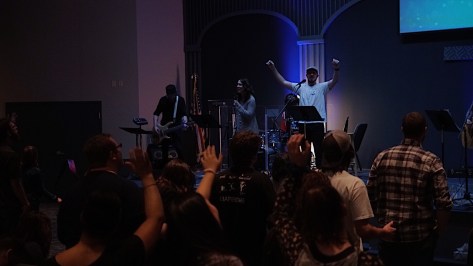
Friday night, I went to one of the Encounter services that my church hosts quarterly for the community. That night I experienced the most joy in worship that I have had in the past year, and it was so encouraging to be in that place again after so many months of despair. But inside I was also pleading with the Lord to take away some lingering pains of loss that continue to creep back into my spirit. The worship team led us in a beautiful, original song that one of the leaders had written, and as the Lord ministered through it, He revealed to me that often loss serves as a conduit through which to receive His love. He reminded me of how He had used the losses in my life to enable me to receive His love more fully and to give my own more readily. He convicted me that instead of trying to erase the lingering pain, I need to be grateful for it because every time I feel it, it sends me running straight to Him. He brought to mind Paul’s words pasted above, written to the Philippian church but timeless in truth for me and others processing hardship: “Yes, and I will rejoice, for I know that through your prayers and the help of the Spirit of Jesus Christ this will turn out for my deliverance.” Rejoice. Pray. Receive the help of the Holy Spirit. Keys to turning loss into deliverance. “…it is my eager expectation and hope that I will not be at all ashamed, but that with full courage now as always Christ will be honored…” Expect.  Hope.  Don’t be ashamed.  Be fully courageous. Keys to honoring Christ in our losses.

It is my natural inclination to run from pain, but I am becoming more and more convinced that God wants me to run into it instead. That He allows loss in our lives—some temporary and some permanent—in order to strip us down to a place where we can more fully receive His love. That the pain of loss is nothing to fear but something to embrace.

This possibility is expressed so powerfully in the climax to the song “In Christ Alone” by Keith Getty and Stuart Townend: “No guilt in life, no fear in death—This is the pow’r of Christ in me; From life’s first cry to final breath, Jesus commands my destiny. No pow’r of hell, no scheme of man, Can ever pluck me from His hand; Till He returns or calls me home—Here in the pow’r of Christ I’ll stand.”

While I sometimes wish that there had been a different outcome to the many losses I have experienced over the past ten years, I also see the deliverance they brought. I may never understand why the stories had to end exactly the ways they ended—why babies were miscarried, why Timothy had to die, why my marriage failed—but I do see the gain.

If I had not miscarried those four babies, I would not have had Lydia. Her birth dramatically changed my life for the better. Every day that I spend with her, she brings me great joy and rightly adjusts my perspective. Without her life, the call to adoption would never have come. Timothy and the twins would not be part of our family. The losses of those four babies were real and they wounded deep parts of me, but what God brought out of them was life-changing and life-giving. Through them, He settled “the solitary in a home” (Psalm 68:6, ESV)—three times over.

Timothy’s death—though unexpected and heartwrenching—made God more real to me than He had ever been before. I had always struggled to feel close to God. I didn’t seem to have the connection with Him that other believers enjoyed, and I wasn’t sure why. But in Bedspace 24 in the Pediatric Intensive Care Unit of the Children’s Hospital of the King’s Daughters in Norfolk, Virginia on the evening of May 15, 2013, I experienced the literal presence of Jesus Christ as He ushered Timothy José Barnes through the gates of heaven. He was as present in that room as I was. All of the Bible studies I had done, prayers I had lifted up, sermons I had listened to, and worship I had offered didn’t come close to deepening my faith and knowledge of Christ the way Timothy’s death did. While I would take Timothy’s life back in a second, the impact of his death on my relationship with the Lord somehow gave it meaning. To die was literally gain.

It is a bit more raw to reflect on possible gains from a marriage that hasn’t finished failing. I once heard that it is best not to write from a bleeding wound, and in terms of absolutes, I agree. Because I serve a miracle-working God, I cannot yet say with certainty how this marriage story will end, even though the foreshadowing is pretty blatant. I am convinced, however, that transparently sharing the unfolding and God’s work in me through that process brings honor and value to the experience and facilitates healing. And I am confident that even though my earthly love story turned dark with deception, infidelity, abuse, and betrayal, it has hurled me straight into the arms of the most honest, faithful, loving, and trustworthy man I have ever known. Jesus has swept me up in a new love story that is far more real and satisfying than I ever imagined possible. He revealed and then killed unhealthy survival tactics in me that needed to die long ago, and then He lavished me with a tender, cherishing love that is mending and softening my broken heart and showing me what it feels like to live truly loved. Whatever ending He writes to my marriage story, I already see that there will have been so much gain from the losses within it.

God answered my prayer at the Encounter last week, but not in the way I expected. I entered His presence to plead with Him to remove the lingering remnants of pain from my loss, but instead He asked me to embrace them—to rejoice in them, to pray my way through them, and to trust the Holy Spirit to use them. He told me to have eager expectation and hope, not to be ashamed, and to have full courage so that He might be honored, no matter the outcome. He reminded me to trust that to die is gain.

I still don’t like the grief of loss—the ache can be unbearable at times—but I am reminded of something else Paul said at the end of that same letter to the Philippians: “…I have learned in whatever situation I am to be content. I know how to be brought low, and I know how to abound. In any and every circumstance, I have learned the secret of facing plenty and hunger, abundance and need. I can do all things through him who strengthens me.” (Philippians 4:11b-13, ESV)

Or as the Amplified Bible insightfully phrases that last familiar verse: “I have strength for all things in Christ Who empowers me [I am ready for anything and equal to anything through Him Who infuses inner strength into me; I am self-sufficient in Christ’s sufficiency].” (Philippians 4:13, AMP)

“No fear in death”…even of the things and people I hold most dear…even of the pain of the losses…because empowered by Christ, “to die is gain.”


Photo taken by Jonah Barnes at The Bridge Christian Fellowship.
Living Loved

IMG_6927

Today is Valentine’s Day, when thoughts turn to monumental decisions like “chocolate or flowers,” “fancy restaurant or romantic dinner at home”? Earlier this week, I felt a sense of dread surrounding this day—the first Valentine’s Day in 31 years without my husband. But then I remembered last Valentine’s Day. I wrote about it in my Day 9 Advent Journal:

Last year Tess spent two-and-a-half months in the hospital and had seven surgeries within a four-month period. Simultaneously, our family was enduring the catastrophic events that I described in yesterday’s journal. Soon after the New Year, my body started reacting to all of the stress. I suffered severe headaches, developed corneal ulcers that destroyed a significant portion of my vision in one eye, and broke out in the most painful rash I have ever experienced. On the day of Tess’s discharge after the seventh and final surgery of her ordeal, I was finally able to slip away to the doctor to get help for the rash. I was emotionally spent from a toxic encounter earlier in the day and was grateful just to sit down in a sterile waiting room at the Tricare Clinic where no one knew me, needed me, or threatened me in any way. When I heard the text notification chime from my pocket, I instinctively reached for it, bracing myself for the likely negative intrusion into my moment of respite. Instead, I saw a message that included these words:

“You are dearly loved, admired, and deeply respected…Your love makes a difference and is beautiful even when unnoticed…You are loved and lovely. I pray that you can always live loved because that is your true identity.”

The words in between these were equally personal and powerful, but those declarations of love in the midst of such an unloving day were what wrecked me. Because as I read them, I realized that this particular cold, dark day happened to be Valentine’s Day and that through one of His sweet servants, God Himself had just delivered my one and only Valentine.

In the 365 days between last Valentine’s Day and this one, I have begun to understand what it really means to live loved, and it has nothing to do with men or chocolate or fancy restaurants.

“And they heard the sound of the Lord God walking in the garden in the cool of the day, and the man and his wife hid themselves from the presence of the Lord God among the trees of the garden. But the Lord God called to the man and said to him, ‘Where are you?’…And the Lord God made for Adam and for his wife garments of skins and clothed them.” (Genesis 3:8-9, 21, ESV)

Living loved is realizing that you believed a lie, turned away from God, and made mistakes that will have consequences for the rest of your life but that He went searching for you, found you, helped you realize you were lost, and made a sacrifice with which He could handstitch a covering for you.

“When Joseph’s brothers saw that their father was dead, they said, ‘It may be that Joseph will hate us and pay us back for all the evil that we did to him.’ So they sent a message to Joseph, saying…please forgive the transgression of the servants of the God of your father.’ Joseph wept when they spoke to him…But Joseph said to them, ‘Do not fear, for am I in the place of God? As for you, you meant evil against me, but God meant it for good, to bring it about that many people should be kept alive, as they are today.” (Genesis 50:15-16a, 17b , 19-20, ESV)

Living loved is forgiving those who commit evil acts against you—even when they strip you of all that you know and love and leave you imprisoned with no sign of justice—knowing that God can use even evil for a greater good.

“Then Pharaoh commanded all his people, ‘Every son that is born to the Hebrews you shall cast into the Nile…a Levite woman…conceived and bore a son, and when she saw that he was a fine child, she hid him three months. When she could hide him no longer, she took for him a basket made of bulrushes and daubed it with bitumen and pitch. She put the child in it and placed it among the reeds by the river bank.” (Exodus 1:22 and 2:1b-3, ESV)

Living loved is trusting God with everything and everyone that you love—even when that means letting them go.

“When Pharaoh drew near, the people of Israel lifted up their eyes, and behold, the Egyptians were marching after them, and they feared greatly. And the people of Israel cried out to the Lord. They said to Moses, ‘Is it because there are no graves in Egypt that you have taken us away to die in the wilderness? What have you done to us in bringing us out of Egypt?…For it would have been better for us to serve the Egyptians than to die in the wilderness.’ And Moses said to the people, ‘Fear not, stand firm, and see the salvation of the Lord, which he will work out for you today…The Lord will fight for you, and you have only to be silent.’” (Exodus 14:10-11, 12b-14, ESV)

Living loved is receiving the deliverance of the Lord and resisting the temptation to flee back to comfortable bondage. It is abandoning fear for faith and resting in His promise to fight for you.

“But Ruth said, ‘Do not urge me to leave you or to return from following you. For where you go I will go, and where you lodge I will lodge. Your people will be my people, and your God my God. Where you die I will die, and there will I be buried. May the Lord do so to me and more also if anything but death parts me from you.’” (Ruth 1:16-17, ESV)

Living loved is welcoming the people God brings alongside you even when it means they sacrifice something to join your journey. It is receiving when you would rather give and humbly admitting that you are in need.

“Then Job answered the Lord and said: ‘I know that you can do all things, and that no purpose of yours can be thwarted’…And the Lord restored the fortunes of Job…And the Lord gave Job twice as much as he had before.” (Job 42:1-2, 10, ESV)

Living loved is holding onto faith in the absolute goodness and sovereignty of God in the face of the unthinkable.

“Those who sow in tears shall reap with shouts of joy! He who goes out weeping, bearing the seed for sowing, shall come home with shouts of joy, bringing his sheaves with him.” (Psalm 126:6, ESV)

Living loved is embracing grief and pain and sorrow, feeling the emotions that make us human, but trusting God’s promises to return them to us as joy.

“I have been crucified with Christ. It is no longer I who live, but Christ who lives in me. And the life I now life in the flesh I live by faith in the Son of God, who loved me and gave himself for me.” (Galatians 2:20, ESV)

Living loved.


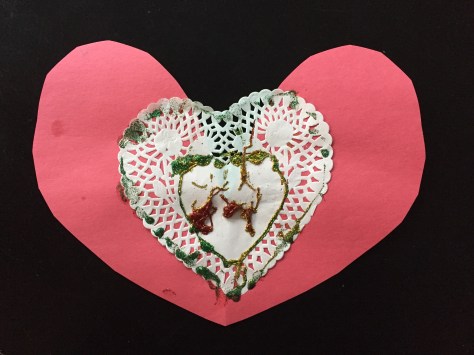
(Valentine created by Lydia Barnes.)

Blossoming

IMG_6898

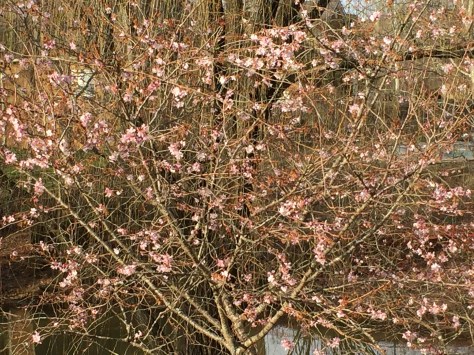
A beautiful little tree lives outside the picture window in my bedroom. In early January, when the Virginia winter pulled one of its identity-crisis weeks and temperatures reached 70, tiny pink blossoms formed on my little tree’s branches, and I wondered if she was a winter-blooming tree. I am notoriously clueless about gardening, and my yard has surprised me repeatedly these past six months as various flowering plants have appeared in unexpected places—the fruit of the previous owners’ labor and design. I took pictures of a pink sunset that January week, loving how it matched my little tree’s new blossoms.

But then the cold snapped back into its rightful place, and I sadly watched my little tree’s blossoms shrivel and die. Soon her branches were as bare as they had been in December, and she blended in with the other forlorn-looking trees in my yard—still beautifully intricate in their barrenness but devoid of color.

This week, another false spring appeared as we enjoyed four days in the 70s! Windows flew open, small piles of sand accumulated on the family room floor beside discarded shoes and socks, and a mosquito even joined us for bedtime stories (where he met his tragic but necessary demise). By the week’s end, I again glimpsed pink blossoms on my little tree’s branches, slightly fuller and brighter than the last time she bloomed. I gazed at them a little more cautiously this time, wondering if they would outlast the cold that had already returned.

I empathize greatly with my confused little tree—wanting to bloom and display the color hidden inside her—but finding her attempts premature and short-lived. I, too, feel eager to bloom—to emerge from my winter season where some things in my life have had to die and be cut away for new life to blossom.

Healing from the loss of yourself and anything you have loved is a messy, slow process. Long, cold, grey days give way to bright, encouraging, warm days. You peek out and see the sun and feel the warmth, so you step out into it and run unencumbered, tasting joy and freedom and loving it! But with no warning, you find yourself back in hibernation listening to the cold rain beat on your window pane, wondering if spring will ever come.

There are so many fast-track ways to “recover” from loss:  party it away; enter a rebound relationship; overwork, overbook, overeat, or overspend; relocate; medicate; serve yourself to death. But filling a void has a much different effect than experiencing healing transformation. It is tempting to choose the fillers because they numb the pain and let us escape the issues and problems that caused it in the first place. But submitting to the process of feeling the pain, grieving it, and being transformed by it propels you to a place so much richer than the one you left.

One of the many reminders that has hung on my little corkboard for the past year is a quote by Joseph Garlington that says, “God closes one door and opens another, but it is hell in the hallway.”

Yep. That pretty much sums it up. It’s hell to be in the middle of transformation. If we could ask the butterfly how the chrysalis feels, she would probably say it feels like you are dying.  That it is dark and claustrophobic and restrictive and that time moves ever so slowly. It’s lonely in there, and it’s an act of total submission to the Creator who promises that He sits on the throne and is “making everything new!” (Revelation 21:5a, ESV)

Like the little tree outside my picture window, I have found the transformation process confusing. Sunny, warm days full of peace and joy and hope bring glimpses of the brightly colored blossoms God is restoring to my life. But then an unexpected cold snap hits, and they all fall to the ground as I realize it isn’t quite spring yet. There are unhealed places in me that He hasn’t touched yet. And it feels like failure.

On one of those cold-snap days, a friend dropped a folded piece of paper into my Bible bag at church. When I discovered it later, sitting in my car in the Starbucks parking lot (where else?), I drank in Natasha Metzler’s words eagerly and silently. When I got to the end, I gasped aloud as I read:

“Nobody makes it through life unscathed by sorrow, and we all feel the scraping sadness at times. And being healed doesn’t mean we’re 100% okay with what’s happening in life. No, no. Being healed means learning to feel all the sadness and all the happy when it comes, all the while knowing that our shalom, our peace and wholeness, is settled deep. It won’t move, no matter what we’re feeling. We’re promised in Philippians 4:7 that the peace of God, which surpasses all understanding, will guard your hearts and minds in Christ Jesus. This means we don’t have to understand everything. Not the loss, not the sorrow, not the lack. We can just know, deep down, that we are safe, even when life hurts. Today, I am feeling 99.8% okay. And as it turns out—that’s enough. Because even though I don’t understand it all, there is a truth that goes far beyond my feelings—and it says that I am whole, even with a thread of sorrow stitched through my my life.”[1]

Through her words, I realized that it’s okay to be confused like the little tree. It’s okay to blossom one day and be barren the next. That even as He transforms and heals me, I will have threads of sorrow and grief woven into my being. And that even after extended weeks of spring and summer, fall and winter will come again. But as long as I submit to the process, avoid the “easy fixes,” willingly feel the sunshine AND the cold snaps, I WILL blossom…again and again…in His time.

For everything there is a season, and a time for every matter under heaven: a time to be born, and a time to die…a time to break down, and a time to build up; a time to weep, and a time to laugh; a time to mourn, and a time to dance…a time to seek, and a time to lose; a time to keep, and a time to cast away…a time to keep silence, and a time to speak…He has made everything beautiful in its time.” (Ecclesiastes 3:1-2, 3a-4, 5, 7b, 11a, ESV)

[1] When You’re 99.8% Okay.” by Natasha Metzler