Home

IMG-4936My three oldest children surprised me with the most amazing early birthday present—a commissioned watercolor painting of my new home! The gift overwhelmed me to tears, which became the source of several conversations between Titus, Lydia, and me for the next twenty-four hours as they attempted unsuccessfully to process the concept of “happy tears.”

This beautiful picture now hangs in the entryway to my home—a perfect location because I see it every time I walk down our hallway as well as every time I enter our home through the front door. I doubt it will ever stop making me smile.

Every mother who receives a tremendously thoughtful gift from her children knows the joy I feel, but this picture is even more than that to me because of all that my home means to me.

Through this home, the Lord has restored peace to my life and the lives of my children.

“The Lord is my shepherd; I shall not want. He makes me lie down in green pastures. He leads me beside still waters. He restores my soul.” (Psalm 23:2-3a, ESV)

The moment I walked into the backyard of this house and saw the creek; the weeping willow trees; the duck family; and the large, hilly yard with endless possibilities for childhood play, I knew this was the perfect home for us. As I peered through the back windows of the master bedroom, family room, and kitchen and saw those same views, I knew that this home had a built-in source of peace and calm that would sustain me through whatever came my way. That has proven true over and over again as I have sat at my picture windows and watched the children play, the rain fall, the duck family swim, the sun set, or the herons take flight. No harsh words, no tension, no fear, no turmoil. Just peace.

Through this home, the Lord delivered me to a secure place where I could live independently and confidently.

“I waited patiently for the Lord; he inclined to me and heard my cry. He drew me up from the pit of destruction, out of the miry bog, and set my feet upon a rock, making my steps secure. He put a new song in my mouth, a song of praise to our God.” (Psalm 40:2-3a, ESV)

Since moving here nine months ago, I have learned (with the generous assistance of a deacon in our church) that I can maintain a home and yard. I can use power tools, start a generator, mount smoke detectors, replace toilet handles, install doorknobs, and solve a myriad of new problems. I have met trustworthy, reliable people to help with the things that are beyond my abilities. My older kids helped me hang Christmas lights on our porch (maybe we will try the gutters next year!), my attic is actually organized (mostly), and the house stays comfortably lived-in but orderly. Instead of being overwhelmed by the responsibility, it has motivated me to do things I never thought I could do, to work hard even when I want to just sit still, and to ask for help when I need it.

Through this home, I saw how much my family loves and sacrifices for me.

“And all who believed were together and had all things in common. And they were selling their possessions and belongings and distributing the proceeds to all, as any had need.” (Acts 2:44-45, ESV)

When it became clear that I was hurting myself and the children by remaining in our previous home environment, the obvious question was where would we go? I looked at rental homes but quickly realized several intrinsic problems. Rentals are temporary and unpredictable and because of their unique needs, my three youngest children required stability and minimal transitions. Pets are not always welcome in rentals, and we had two dogs. Thinking about the stress of being in someone else’s home with all of the inevitable potty accidents, g-tube leaks, rogue Sharpies, and vomiting episodes overwhelmed me. I didn’t see any other options—even though I had strong credit scores, teaching an online writing course did not remotely yield the income necessary to qualify for a mortgage. But my family saw options—each and every one of them. They had been waiting patiently for me to see what they had seen months earlier, and they stood ready to pool their resources in one of the greatest acts of love I have ever experienced. Thanks to an incompetent loan officer, the process was laden with frustration at every turn, but God kept making a way where there seemed to be none. The day I turned the key in the lock of my very own home was a glorious day in which the impossible became possible.

Through this home, the Lord showed me that His plan is far superior to mine.

“The heart of man plans his way, but the Lord establishes his steps.” (Proverbs 16:9, ESV)

Once I had made the decision to move out, I started seriously searching for a home. Very quickly, I found the perfect place for us. It was a flipped house with brand-new everything, had a large backyard, and was within walking distance of our church. I couldn’t act on this home right away because several things needed to happen first. So I watched it and prayed for it to remain available. Friends looked at it and prayed with me. When the time came that I could make an offer, I just knew that God had held this house for me. But things did not go as expected, and the door seemed to be closing on my “perfect” house. I was confused and mad at God. As I cried out to Him in frustration, He revealed some false hope and lingering fear that was holding me back from walking forward in confidence that moving out was truly His will for me. As I released those to Him, He led me to my current home AND re-opened the door to the “perfect” home I had been praying about for over a month. The decision was pretty clear the minute I saw the backyard of this house, but it was sealed the next morning when one of my best friends returned from a trip and sent a text inquiring about “my house.” She meant the original house because she had gone to see it with me and had been praying with me that the house would remain available. She had been visiting her daughter and didn’t know about the events of the past few days. When I texted back to let her know that I was about to pursue a different house, she asked for the address to look it up. Not a minute later, I received a text that gave me chills: “You are not going to believe this. Michael (her husband) and I built that house in 1993.” Through all the bumps of the remainder of the home-buying process, I never had another moment’s doubt that this was the house God had for me all along. His plan is always superior to mine.

Through this home, I learned that God will provide for me and that all that I have is actually His.

“Even the sparrow finds a home, and the swallow a nest for herself, where she may lay her young, at your altars, O Lord of hosts, my King and my God. Blessed are those who dwell in your house, ever singing your praise!” (Psalm 84:3-42, ESV)

Soon after moving in, I began to feel guilty for how much I loved my home. I even prayed a prayer telling God that I was sorry if I loved the house and yard TOO much. In my devotional time soon after, He led me to a study of Psalm 84. And through that study, I realized that the house isn’t actually mine. It is His. And I am privileged to dwell in it. And when I sit in my special chair and look out over the creek and through the weeping willow trees and see the herons and the ducks live their lives before me or watch the sun set in glorious pink and purple hues, I am at His altar. I am singing His praises and being grateful for His provision and soaking in the peace and sharing the joy with my children and all who visit us here.

I cherish every memory we make here—celebrating holidays and birthdays, welcoming friends, making music, telling stories, cooking, watching movies, playing games, reading books, writing words—even experiencing disappointments, recovering from sicknesses, and crying tears. This is truly my favorite of all the homes I have ever lived in, and I hope I can live here for the rest of my life. But if God leads me somewhere else, I will be sure to follow because He has shown Himself faithful to always lead me home. 

Commissioned watercolor painting of 1004 Wymers Court created by Adriana von Helms (Instagram handle:  art.adriana.gail).
Desperate

IMG_6932

A young woman has just been accepted to a nationally acclaimed graduate program in her field and awarded an assistantship that will pay her tuition and a stipend for her entire program. Just after enrolling in her first classes, she misses a period. Her head spins with possible scenarios and lands momentarily on the thought of abortion—a viable solution in her 24-year-old mind because, in that moment, she feels desperate.

An older mother of four healthy children miscarries four babies in eighteen months. She accepts that her family must be complete only to learn that she is pregnant again. Soon after realizing this pregnancy appears to be viable, she receives a call that test results indicate a high likelihood that her baby has Down syndrome. Genetic counselors want more invasive testing, the obstetrician suggests termination, and her heart and mind begin to race. She feels desperate.

A young Filipino couple gives birth to a premature baby boy who is diagnosed with Down syndrome and Tetralogy of Falot, a rather complex congenital heart defect. The couple had come to the United States to give birth to their son so that he would have the best possible medical care but planned to return to the Philippines soon after his birth. The thought of taking this medically fragile baby back to their country where he would likely die overwhelms them, and they feel incredibly desperate.

A French couple who has battled cancer goes to great lengths to have a baby of their own—invitro fertilization with a donor egg and a surrogate mother made them parents-to-be of twins! But at 29-weeks gestation, the surrogate mother is rushed to the hospital for an emergency c-section. Born prematurely, the twins suffer severe brain bleeds. Desperate, the babies’ parents leave the twins in the care of a local adoption agency and return to their home country.

In our media-saturated era, platforms abound for heated discussion of when life begins and who has the right to terminate it, about which lives are worth living and which are better ended, about taking a stand for or against. It is so tempting to draw a line in the sand and declare “sides” and positions, but that rarely seems to produce anything of substance. A more worthwhile pursuit is to listen to the stories—the people behind the positions and polarizing statements and passionate words. The same theme runs through most of them—desperation.

We face decisions every day of our lives. Most are inconsequential, but others change the course of our lives or someone else’s forever. For every drunk driver who takes an innocent life, there are many more who caught a ride home with a sober friend. For every unwed teenage girl who finds herself pregnant, there are likely many others who made the same choice that led to that pregnancy but with no visible consequence. For every driver whose momentary glance at his cell phone cost him his life, there are countless others whose distraction had no such price. It’s a fine line between the casual decision and the unthinkable consequence—a line we all walk every day.

As the debates rage on in the public arena, I think of where Jesus would be if He walked the earth today. He would be ministering to the desperate. His life testifies to that. The woman who had been bleeding for 12 years reached out to touch the hem of His garment—desperate. He felt the power go out from Him and turned to see whose faith had made her well—ministering to the desperate. He heard the cries of Martha and Mary for their brother Lazarus, dead for four days, entombed and stinky—about as desperate as a person could get. And He called Lazarus forth, right out of that tomb and into life—ministering to his and his mourning sisters’ utter desperation.

The words murder and infanticide evoke outrage and are intended to provoke extreme reactions. Both are horrific crimes that steal lives from individuals. But behind most murders are also desperate people. When the Lord rejected his sacrifice, Cain allowed anger to overtake him. Desperate, he “rose up against his brother Able and killed him” (Genesis 4:8b, ESV). Moses, a Jew raised by Pharaoh’s daughter, grew up and saw his people in bondage. One day he walked among them and saw an Egyptian beating a Hebrew. Desperate, “he struck down the Egyptian and hid him in the sand” (Exodus 2:12b, ESV). Late one spring afternoon when he should have been out fighting with his troops, David lusted after and slept with Bathsheba, the wife of Uriah, leaving her pregnant with David’s child. Unable to manipulate a cover-up that would make Uriah think that baby was his, a desperate David sent an order to “[s]et Uriah in the forefront of the hardest fighting, and then draw back from him, that he may be struck down, and die” (2 Samuel 11:15, ESV).

Jesus never condoned sin or murder; in fact, his views of what constitutes murder were extreme: “You have heard that it was said to those of old, ‘You shall not murder; and whoever murders will be liable to judgment.’ But I say to you that everyone who is angry with his brother will be liable to judgment” (Matthew 5:21-22, ESV). But Jesus also willingly went straight to the desperate, spoke into their painful situations, and reached out a hand. He offered living water to the woman at the well who had five husbands and was in an adulterous relationship (John 4:1-45). To another woman caught in adultery, he scattered those about to stone her by simply bending down and writing on the ground, then issuing a challenge that the man without sin should “be the first to throw a stone at her.” Left alone with the woman, Jesus declared, “Neither do I condemn you; go, and from now on sin no more” (John 8:7b, 11b, ESV).

Knowing and speaking what we believe is incredibly valuable. Knowing what the Word says about life is critical. But seeking the desperate and reaching out a hand speaks a stronger truth than words or platforms. We all have a circle of influence, and it isn’t just our families and friends. It’s our bank teller, our hair dresser, our mail carrier, and our bus driver. Among them are undoubtedly desperate people walking that thin line between the casual decision and the unthinkable consequence. To influence decisions about life, we need to see the desperation in those around us, reach into it, and find ways to make it less desperate.

Carrying placards outside abortion clinics makes a statement to those entering or driving by. Marching for life in Washington draws attention to the tragedy of abortion. Calling out lawmakers for introducing legislation that makes it easy to terminate life for convenience seems noble. But most of those actions are not likely to reach the people walking into those clinics who have already wrestled with their desperation and found no way through it, only a way out.

In the scenarios that opened this piece, I was both the young graduate student who contemplated abortion and the older mother encouraged to terminate her pregnancy. The Filipino man and woman were the birth parents of my adopted son, and the French couple gave life to my adopted twins. Since those graduate school days, I have seen and felt desperation that has transformed my views of what it really means to stand for life.

Standing for life is saying no to the genetic counselor and obstetrician who encourage us to terminate even if it means saying yes to a life very different from the one we planned. It is getting to know the unwed expectant mother who fixes our coffee in the hospital coffee shop, meeting some of her tangible needs, and reassuring her fears about delivery. Standing for life is working with churches and other organizations who offer tangible and long-term support to women in crisis pregnancies so that they can endure nine months of hardship to give life, even if they decide someone else is better positioned to raise that life. Standing for life is opening our hearts and families and homes to babies and children that others are unable to raise, especially those who have special needs or siblings that make them more difficult to place.

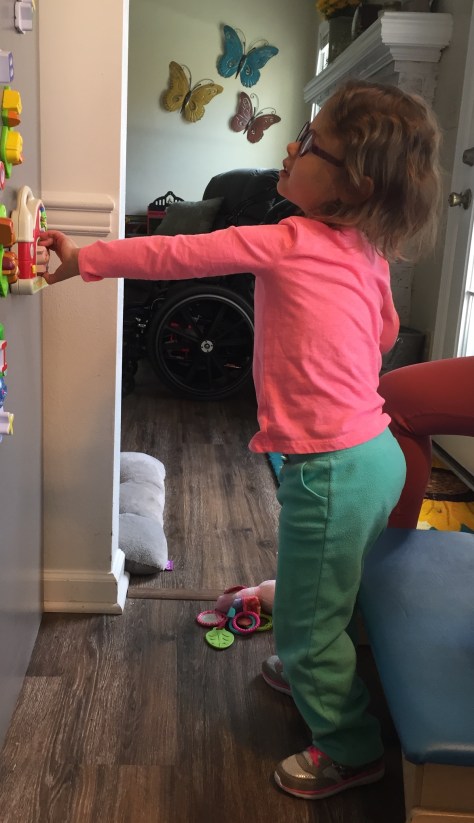
Standing for life is waking up every day and figuring out what it will take to help children with extra challenges overcome the odds, defy the predictions, and push the limitations just a little bit farther than they pushed them yesterday. It is whispering into my daughter’s ear that she is beautiful and strong and smart and that one day she will go to college and have a job; it is believing with all my heart that the extra copy of the 21st chromosome that resides in every cell of her body does not cancel out her potential for greatness. It is helping my son manage the environment that tries to overwhelm his senses, seeing his strengths, and compensating for his weaknesses without letting him know that he is any different from any other kid he sees; it is recognizing that it is critical that he feel loved and valued and able and that the longer he can keep those truths as his core identity, the less ravaging his challenges will be to him. And it is standing back while my 5-year old daughter struggles to crawl up the three little stairs from her bedroom to the kitchen, navigate her walker in tight or crowded spaces, and use the hand her brain doesn’t like to remember is even there; it is trusting that in standing back, I am helping her learn strength, develop resilience, and harness the power within her.

Like Jesus did, we must scan the masses of people who surround us and find the desperate ones. Listen to their stories, encourage them, and support them tangibly or connect them with someone who can. Stand for life—one messy, stress-filled, exasperating day at a time. And when the desperate see us standing there willing to engage, to help, to adopt, perhaps they will choose to stand with us. And one day maybe debates in the public arena will be silent on the issue of abortion. Maybe it won’t matter what laws are on the books because there will be so many better alternatives for desperate people.