Risky Business

IMG-5261Two years ago, I stumbled up the stairs of a counseling center in Norfolk. I had not slept or eaten in days. My hair stuck out all over my head because that morning, I had tried unsuccessfully to lift my hairdryer to my head—not because I was too physically weak but because I could not stop crying. A friend had come over to step into my day so that I could find a way to breathe again. When I climbed those steps, I went seeking my way through unthinkable circumstances that had shattered my life. Over the course of that summer, what I found was myself. I did not even know I had lost her.

A little over a month ago, I took a series of “tests” my counselor recommended to help me find focus in my new season of life.  She thought it would help me to better understand my identity that had somehow gotten buried under decades of debris.  Who expects to “start over” just shy of their fiftieth birthday?!? The sense of urgency to “get it right” is a whole lot greater than it was at twenty, so I very willingly engaged in this process designed to help me better understand myself—my needs and values, my passions and strengths.

One of the assessments measured competencies in my life—things I am good at. When the counselor who conducted the assessment shared my top three competencies, I almost choked on my laughter. One of them was “Taking Risks” and it said, “You are motivated to go on adventures and explore new territories. Your desire for excitement and competition will involve you in entrepreneurial and challenging circumstances so you can overcome obstacles and enjoy the rewards of victory” (Pro-Development assessment report).

“That’s not me,” I told the counselor. “I am not a risk-taker.”

He raised his eyebrow at me, “Oh, really? When I first heard your adoption stories, my immediate thought was, ‘That was risky.’”

Right then and there in that small counseling room in Norfolk, Virginia, my reality crumbled. This girl who hates flying in airplanes, who doesn’t swim in the ocean to guarantee she will not be eaten by sharks, and who would not take a million dollars to hang-glide or parasail or jump off a diving board at the YMCA (okay, MAYBE I would jump off the diving board for a million dollars, but it would also require medication of some sort)….this girl is a risk taker?! My mind was blown.

I played with the thought for days, turning it over and around to consider it from different angles. I looked for evidence of it in my life, and slowly I began to see that the problem wasn’t that the test misunderstood me to be a risk taker but that I had a very narrow view of risk. I thought of risk as a physical act—doing things that required signing extensive waivers because they may result in death. And those things ARE risky, and I have absolutely no desire to do any of them. Not one. Ever.

But not all risks are physical—some are emotional, financial, or spiritual. And when I examined my life through this new lens, the past ten years were littered with evidence of risk in all of those areas. And when I scraped away the acts and looked underneath, I saw no innate desire for adventure in myself but a simple longing to live a life of trust.

Today is Easter and we are celebrating the most miraculous event in the history of the world. Yet one of the first things we awakened to was news of the deaths of hundreds of innocent people worshipping and living life in Sri Lanka. And just like that, the darkness threatened to overshadow the joy. I felt darkness try to overshadow my joy before I even heard this news. It was thick like a cloud that surrounded me—blinding, choking, and suffocating me. I can only imagine the thickness of the cloud covering the people of Sri Lanka right now—and of anyone else who woke up on Easter Sunday to devastating news of death, cancer, divorce, or personal despair.

There is only one way to dispel the darkness, and it is risky. It is what motivated Mary Magdalene to go to the Jesus’s tomb before the sun even rose on the day after the Sabbath. It is what emboldened the disciples, despite their gripping fear, to gather in the upper room instead of dispersing and scattering to protect their individual lives. Underneath every risky act is a trust in something—or Someone.

The tomb was dark. Jesus entered it having been physically crucified, one of the most torturous forms of death. Worse than that, He felt utterly forsaken by His father. He descended into hell, the darkest place imaginable. All because He trusted the plan of God the Father and knew the sacrifice required to atone for the sin of every person who has lost him or herself and needs to be found.

So all I know to ask myself today and everyday in the face of personal darkness and international tragedy is, “Do you want to stay in the tomb or do you want to live?”

The tomb may be dark, but it feels safe and familiar. It also holds nothing but death.

To live is to trust the goodness of God in all circumstances—even evil and unjust ones. And when we trust, we risk everything. We hand over our control, our agenda, our feelings, our will, and our very lives. We walk with no view of the end of the path, no sign of the shore, no vision of the story’s ending. And sometimes we experience great pain, disappointment, or loss. It is then that we join in the fellowship of Christ’s suffering, which is both the greatest risk and the greatest reward.

Paul wrote about this risky business in his letter to the Philippian church, “But whatever gain I had, I counted as loss for the sake of Christ. Indeed, I count everything as loss because of the surpassing worth of knowing Christ Jesus my Lord. For his sake I have suffered the loss of all things and count them as rubbish, in order that I may gain Christ and be found in him, not having a righteousness of my own that comes from the law, but that which comes through faith in Christ, the righteousness from God that depends on faith— that I may know him and the power of his resurrection, and may share his sufferings, becoming like him in his death, that by any means possible I may attain the resurrection from the dead. (Philippians 3:7-11. ESV)

I may never swim in the ocean or parasail or even dive off the diving board at the YMCA, but I am a risk taker. The biggest risk I ever took was trusting Jesus—following Him, losing my life, and finding my lost self. Dangerous business. But the alternative is worse than dangerous—it is deadly.


For whoever would save his life will lose it, but whoever loses his life for my sake will find it.” (Matthew 16:25, ESV)
 

Free Indeed

IMG-5217.JPG

Cathy B. lived next door to me on Bob White Court.  Hers was the big house on the hill, so we all flocked to it on snow days.  Some weeks she was my very best friend; others she was downright mean—a very typical childhood girlfriend.

I remember Cathy for all the fun times we had on our cul-de-sac because we grew up in the years just before VCRs and Atari Video Game Systems changed childhood forever.  Our days were spent playing Nancy Drew in the yard, riding our bikes, making up elaborate games with ever-evolving rules, torturing our younger brothers (both named Robert), and playing “house” in the woods behind our house.  That was fun until we accidentally used poison ivy leaves for powder puffs.  Cathy’s mom figured it out first, so a quick bath spared her more than a mild reaction.  My eyes were swollen shut for days.

But those memories aren’t the only reason I remember Cathy.  Her family went to the Baptist church up the road from our neighborhood, and around the fifth grade, she started taking me to the Wednesday night programs with her.  My family was what one of my former pastors identified as CEO Christians—Christmas and Easter Only—so attending church outside of a major religious holiday was foreign to me.  I became a GA—Girl in Action.  Not only did I like the meal, fellowship, and fun, but I picked up some moral values as well.  I remember sitting on the basement floor one Wednesday night, listening intently to the leader say that “Sex is God’s wedding present, and you shouldn’t open it early.”  That statement literally formed the entire basis of my sexuality values for the next decade.  Talk about common grace.

Cathy moved away, and the Taylors moved into her house.  They only had young kids, so my outdoor adventures with Cathy and the Roberts ended.  But my experiences at her church did not.  I started going on Sundays and eventually joined the youth group.  One Sunday when I was thirteen years old and reeling and confused by my parents’ unexpected separation and subsequent reconciliation a few months later, I accepted an altar call and found myself scheduled for baptism a few weeks later.  This would be purely joyous news except for the fact that I was afraid of putting my face underwater without goggles AND a nose plug, and this WAS a Baptist church after all, so immersion was the only baptism option.

At age thirteen—fully THE most self-conscious age in a teenage girl’s life—another issue with this impending baptism was the fact that I would emerge from the baptismal font with wet hair, in full view of the general public.  I spent hours on my hair each day.  This was completely unacceptable.  So…if I am honest about my baptism day, I mainly remember holding my nose for dear life while the pastor dunked me, immediately putting on the cute French beret that I had purchased solely for the purpose of minimizing the mortification of my wet hair and being pleased that both my mother AND father attended the baptism.  Nothing spiritual about that.

Perhaps that’s why I constantly felt the need to “accept Christ as my Lord and Savior” over and over again for the next several years—at youth group, at multiple Fellowship of Christian Athletes meetings, on a beach retreat.  It just seemed like I couldn’t possibly have done it right the first time, so doing it over and over again would surely solve that.

I wish I could say that this was the beginning of a beautiful journey of a life of faith, but the truth is that my involvement in faith communities fizzled during my sophomore year of high school.  I often liken it to the Parable of the Sower.  I was one of the seeds that “fell on rocky ground, where they did not have much soil, and immediately they sprang up, since they had no depth of soil, but when the sun rose they were scorched. And since they had no root, they withered away” (Matthew 13:5-6, ESV).

The story that falls in the years between these is long and winding and best saved for many other days.  It includes diversions such as joining a cult, becoming agnostic, and confusing religion with faith.  It reveals more failure and weaknesses than I would like to admit and culminates in a Job-like journey that knocked me face down in the dirt while all that I lived for disintegrated around me.  And as I have been rubbing the dust out of my eyes and slowly crawling back to my feet, I am finally able to see what Christ gave me when I encountered him at Cathy B.’s church all those years ago—Freedom.

I know that Easter is this week, and my thoughts should be on crosses, tombs, eggs, and bunnies.  But instead, I have been reflecting on shackles and chains.  In church today, we sang one of my favorite songs, “You Came (Lazarus)” (lyrics by Bethel Music and Amanda Cook).  As we worshipped, I saw a vision of the Holy Spirit swirling around me unlocking shackles and chains.  All week, God has given me picture after picture of the freedom He has given me.  Salvation isn’t just about eternal life after I die but eternal life that began the moment I relinquished control of my life to Christ. That is when the chains and shackles began to fall off me.  For it was the illusion of control–the notion that I could have it and the lie that I would even want it–that bound me in the first place.  But because He came and He died and He rose and He lives, I can LIVE FREE…

I am free from the judgment of others.  All that matters is what He thinks of me, and there is nothing I can do or say that will make Him love me any less or any more than He does right now.  “For I am sure that neither death nor life, nor angels nor rulers, nor things present nor things to come, nor powers, nor height nor depth, nor anything else in all creation, will be able to separate us from the love of God in Christ Jesus our Lord.”  (Romans 8:38-39, ESV)

I am free from condemnation.  My sins do not define me and unless I refuse to acknowledge and confess them, they do not disqualify me from serving.  What I cannot do, He has done for me, and the more I give myself to Him, the more power I will have over the sin in my life.  “There is therefore now no condemnation for those who are in Christ Jesus. For the law of the Spirit of life has set you free in Christ Jesus from the law of sin and death.”  (Romans 8:1-2, ESV)

I am free from shame.  I always thought shame was reserved for our secret sins, but after reading the work of Brené Brown, I have a new appreciation for shame.  In her book Daring Greatly, she defines shame as the “intensely painful feeling or experience of believing that we are flawed and therefore unworthy of love and belonging” (p. 69).  Shame devastates people and relationships, and the more I understand it, the more I want no part of it—either as a recipient or as an inflictor of it.  The Lord declares victory over shame, and living free means I must receive that.  “You shall know that I am in the midst of Israel, and that I am the Lord your God and there is none else.  And my people shall never again be put to shame.” (Joel 2:27, ESV)

I am free from bondage.  The enemy can whisper his lies, send his diversions and decoys, and go after all that I love, but at the name of Jesus he has to flee.  “For the creation was subjected to futility, not willingly, but because of him who subjected it, in hope that the creation itself will be set free from its bondage to corruption and obtain the freedom of the glory of the children of God.”  (Romans 8:20-21, ESV)

I am free from being controlled by my emotions.  God gave me feelings, but those feelings don’t have to rule me.  I can feel grief, anger, joy, and despair without dwelling in those places.  The more I focus on Christ, the more willing I am to even feel the painful feelings, knowing that they are there to alert me to something in myself or my circumstances that needs attention.  “Weeping may tarry for the night, but joy comes with the morning.” (Psalm 30:5b, ESV)

I am free from circumstances.  In the song, I referenced above, Mary and Martha’s prayers are answered (albeit later than desired), and Jesus called their brother Lazarus forth from his tomb.  But the miracle isn’t the healing but the fact that Jesus came into the place of despair.  I learned this when my son died and when my marriage failed and when I lost the family unit I had lived for.  Circumstances happen around and to me, but their outcomes change nothing about the source of my identity, my purpose, or my reality because those things are based on an unchanging God.  “Everyone then who hears these words of mine and does them will be like a wise man who built his house on the rock. And the rain fell, and the floods came, and the winds blew and beat on that house, but it did not fall, because it had been founded on the rock.” (Matthew 7:24-25, ESV)

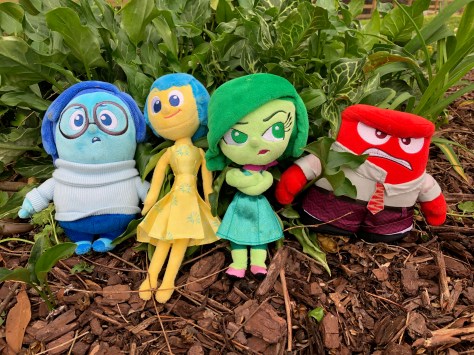
I am free from fear.  The other day Titus was rediscovering some stuffed animals that had been hidden deep in his closet.  He pulled out several characters from the movie Inside Out, proclaiming their names excitedly with each extraction:  “Look, Mom!  It’s Anger!  Oh, here’s Sadness!  And Joy and Disgust!”  As he dug further in the bag, he looked up at me with concern and questioned, “Where’s Fear?”  Slightly distracted, I answered him without thinking, “Oh, we don’t have Fear.”  Immediately, I paused, struck by the power of that statement. I claimed it right then and there–for our family, our home, and every aspect of our lives.  “There is no fear in love, but perfect love casts out fear. For fear has to do with punishment, and whoever fears has not been perfected in love. We love because he first loved us.” (1 John 4:18-19, ESV)

Because He came and died and rose and lives, I am free from all of those things, but I am also free TO things.  I am free to believe, to hope, to worship, to love, to give, to receive, to serve.  I am free to live.  I am free indeed.


“So if the Son sets you free, you will be free indeed.” (John 8:36, ESV)


The Stone I Carried

IMG-5105On Tuesday, April 2, 2019 at 7:09am, I placed a small, irregular-shaped, black stone in my left hand. Flecks of white, grey, and silver were scattered throughout my stone, which was why I had chosen it from among the thousands of options lining the ground beneath my deck. I proceeded to hold it in my hand nonstop for six hours. I held it while I dried my hair and realized that my hair is rather flat when I try to style it with a stone in one hand. I held it while I dressed the children and fixed their breakfast and realized that it is more difficult to care for little people when your hand is grasping a small stone.
Within a short while, I noticed that the stone made my palm sweaty, and by the end of the six hours, my hand felt stiff, clammy, and a little raw. I noticed the stone constantly at first, but after a couple of hours, it seemed like part of me. Even as it continued to inhibit my activities, it felt attached to me as if it belonged there. At one point I carried a small pile of items from one room to another and noticed that as I released them from my grasp, I had to make a conscious effort to hold onto my stone rather than letting it go with the other items.

The six hours passed more quickly than I expected, and at no point did the stone leave my palm. I had fully expected to drop it or need to put it down at least once or twice; however, clinging to it quickly became instinctive.

The stone I carried for six hours on the morning of April 2nd represented unforgiveness. The act of carrying it was an exercise I was instructed to complete while reading The Book of Forgiving by Desmond and Mpho Tutu, one of several resources God has graciously led me to over the past few months.

From the experience, I drew the following conclusions…

Carrying unforgiveness feels cumbersome at first but gradually becomes deceptively natural.

Carrying unforgiveness affects my physical appearance and leaves me feeling stiff and raw.

Carrying unforgiveness affects almost everything I do in some way.

Carrying unforgiveness inhibits my ability to help others.

When I cling to it, unforgiveness begins to feel like a natural part of me.

When I hold to unforgiveness, I am unable to fully open my hands to receive.

Unforgiveness serves no useful purpose whatsoever.

Unforgiveness offers nothing of value to me or those I love and serve.

Letting go of unforgiveness requires a conscious, willful act.


In the chapter of the Tutus’ book that assigned this exercise, the following poem is offered:

“I will forgive you

The words are so small

But there is a universe hidden in them

When I forgive you

All those cords of resentment pain and sadness that had wrapped

Themselves around my heart will be gone

When I forgive you

You will no longer define me

You measured me and assessed me and

Decided that you could hurt me

I didn’t count

But I will forgive you

Because I do count

I do matter

I am bigger than the image you have of me

I am stronger

I am more beautiful

And I am infinitely more precious than you thought me

I will forgive you

My forgiveness is not a gift that I am giving to you

When I forgive you

My forgiveness will be a gift that gives itself to me”

(from p. 26-27 of The Book of Forgiving by Desmond Tutu and Mpho Tuto)


May I always remember the stone I carried and the One who empowers me to lay it down.


“Then Peter came up and said to him, ‘Lord, how often will my brother sin against me, and I forgive him? As many as seven times?’  Jesus said to him, ‘I do not say to you seven times, but seventy-seven times.’” (Matthew 18:21-22, ESV)

Curveballs

IMG-5104

Baseball is back on my mind after decades of absence. Next week Titus and Lydia will start playing Challenger Baseball, a division of our local Little League for children with disabilities. We have been practicing catching, throwing, and batting in anticipation of their first game. The extent of our backyard practice goals is for them to keep their eyes open long enough to see the ball coming toward them in order to catch it rather than be hit by it.

From my teenage years, I have many fond memories of dusty, dirty, spit-filled dugouts. I kept score for our high school baseball and basketball teams and even throughout college. I met my best friends and every guy I ever dated through my years of scorekeeping for baseball and basketball teams and felt as comfortable in dugouts and gymnasiums as anywhere else.

Most anyone familiar with baseball knows that in simple terms, a curveball is a type of pitch in which the pitcher puts a specific spin on the ball in order to make it drop just as it approaches home plate. This is obviously intended to throw the batter off and make the pitch more difficult to hit.

The day after I posted my last blog entry called “Home,” I encountered the first of two significant curveballs in my own life. It happened to be my birthday, and I was anticipating as enjoyable a day as one could hope for when her birthday falls on a Monday. The kids were ready for the day, and Titus and Tess were in Tess’s bedroom building elaborate structures with her large assortment of colorful MegaBlocks when I noticed a small puddle of water on the floor by her feeding pump. Thinking I must have spilled some of her medicine earlier in the morning, I wiped the puddle and went about my morning.

A few minutes later, I re-entered the room only to see the same puddle on the floor. “I thought I wiped that up,” I told myself as I bent down to wipe the water off the floor.

Several minutes later, I again entered the room and saw the same puddle and another smaller one just beside it. Trusting that I was not absentminded or distracted enough to have thought I had already wiped the same puddle three times, I examined the floor more closely and realized that water was coming up from under Tess’s floorboards. A few hours later, I received an extremely undesirable birthday gift: news of a broken pipe under our house that had saturated the insulation, the support beams, and Tess’s brand new floors. Within 24-hours, all of Tess’s belongings were in a storage box on our driveway, two holes were cut in the wall of her room, fans and dehumidifiers were whirring, and Tess’s new floors were torn up.

Recognizing that I had just written about how much my home meant to me, I saw this curveball as an enemy strategy to directly target something I had openly shared to be a source of strength and a gift from the Lord, and I resolved to be unaffected by the strike. But a week later, just as the recovery and restoration process of Tess’s room neared the halfway point, another curveball barreled toward home plate.

I had been anxiously awaiting our March 27 custody and support hearing. Desperate for financial support and binding custody orders, I was eager for the slow-moving wheels of the justice system to speed up. The Saturday night before our Wednesday hearing, as I drove home from having dinner with a friend, I felt the Lord direct me to go to the courthouse. It was already dark, so my rational brain did not think this wise, but the Spirit insisted. Alone and in the dark, I pray-walked around the Chesapeake Juvenile and Domestic Relations Courthouse seven times, each time praying for one of our five minor children and the first and final times, praying for the judge and attorneys and for my own financial situation and strength on trial day. When I drove away, absolute peace overwhelmed me.

Three days later, the evening before our hearing, my attorney called with the unexpected news that our judge had put in retirement papers effective immediately and would not hear our case the next day. A substitute judge would sit on the bench but would likely only hear the support portion of the hearing and continue the custody portion.

I am not proud to say that my immediate reaction to the news was despair. I had already experienced a four-month delay from our last scheduled trial date and had been desperately counting the days until March 27. About two hours into this despair, the Lord chastised me with a clear admonition. He reminded me of my seven-lap prayer walk in which I supposedly relinquished to Him every aspect of this trial and drove away with a complete sense of peace in His sovereignty over the trial and its outcomes.

I knew that the Lord was reminding me that if I truly trusted Him, I would know that He had either allowed or orchestrated this unexpected curveball and that to do anything other than continue to trust Him would be to prove myself either weak in my faith or a liar.

If a batter doesn’t keep her eye on the ball, she will be deceived by an unexpected curve and likely miss the ball altogether or catch the tip of it. I may not have been a ballplayer in my youth, but as the scorekeeper, I knew full well the consequences of both of those responses.

Before this season of loss and rebirth in my own life, I reacted terribly to curveballs. They threw me off course, made me angry, tempted me to blame or lash out at others, stole my joy, or left me in despair. None of those responses reflected trust in the sovereignty of God.

The Apostle Paul faced an extraordinary number of curveballs in his ministry. As I have studied the book of Acts with my Community Bible Study group this year, I have been struck by how many times Paul was seized, accused, beaten, and imprisoned on his three missionary journeys. No matter what he faced, his kept his steady gaze fixated on the Lord, his actions focused on preaching the gospel, his resolve steady, and his heart positioned toward complete trust in Christ.

In his letter to the Romans, Paul wrote, “For we know that the whole creation has been groaning together in the pains of childbirth until now. And not only the creation, but we ourselves, who have the first fruits of the Spirit, groan inwardly as we wait eagerly for adoption as sons, the redemption of our bodies. For in this hope we were saved. Now hope that is seen is not hope. For who hopes for what he sees? But if we hope for what we do not see, we wait for it with patience. Likewise the Spirit helps us in our weakness. For we do not know what to pray for as we ought, but the Spirit himself intercedes for us with groanings too deep for words. And he who searches hearts knows what is the mind of the Spirit, because the Spirit intercedes for the saints according to the will of God. And we know that for those who love God all things work together for good, for those who are called according to his purpose.” (Romans 8:22-28, ESV)

Following Paul’s lead means recognizing the fallen nature of man and creation and all the pain that brings. It also means anticipating redemption of all that is broken and patiently living in hope of that redemption even when we do not see signs of it. It means relying on the Spirit when we feel weak, allowing the Spirit to intercede for us when we do not have the words we need. And it means knowing that He works all things together for good in our lives. Not hoping that but KNOWING it. Not some things but ALL things–even the curveballs.

My two recent curveballs were minor in comparison to others in my own life and those of many who have faced far worse circumstances than I can imagine, but the best thing about experiencing curve balls is the total refocusing they require. An effective curveball will leave a batter more alert, more focused, more intent than she was when it came across the plate and earned her a strike.

Both of my circumstances had favorable outcomes. Tess was out of a bedroom for two weeks and I was out a deductible, but the repairs were made quickly and competently and her room was restored with the unexpected perk of a new paint job that replaced a color I had grown to detest. The substitute judge assigned to our trial forgot to come to court, and though we could have walked out with nothing but a new trial date, our attorneys negotiated temporary agreements that would sustain me until August when our new judge would hear the case.

But in both situations, the best “result” was the reminder that my hope is not in circumstances—whether a house or a judge—but in the God who controls all. My beloved house could fall down around me and the trial could bring negative outcomes, but if my eyes stay focused on Jesus, the “founder and perfecter of my faith,” it won’t matter if I hit a homerun or strike out swinging because He will lead me through either situation with a full knowledge that I cannot comprehend. If He allows or even orchestrates a curve ball, it is because He sees the necessity or benefit of it, and who am I to question that?

I hope the day comes when my first response to life’s curveballs is to turn to the Lord and say, “Wow! I didn’t see that coming, but You did and I trust You. Help me see Your hand in this situation. Show me what to do now.” Until then, I will work on shortening the duration of my “tantrums,” throwing my bat or cap a little closer to the plate, dusting them off a little more quickly, and stepping back into the batter’s box with renewed focus.


“For my thoughts are not your thoughts, neither are your ways my ways, declares the Lord. For as the heavens are higher than the earth, so are my ways higher than your ways and my thoughts than your thoughts. For as the rain and the snow come down from heaven and do not return there but water the earth, making it bring forth and sprout, giving seed to the sower and bread to the eater, so shall my word be that goes out from my mouth; it shall not return to me empty, but it shall accomplish that which I purpose, and shall succeed in the thing for which I sent it. For you shall go out in joy and be led forth in peace; the mountains and the hills before you shall break forth into singing, and all the trees of the field shall clap their hands. Instead of the thorn shall come up the cypress; instead of the brier shall come up the myrtle; and it shall make a name for the Lord, an everlasting sign that shall not be cut off.” (Isaiah 55:8-13, ESV)