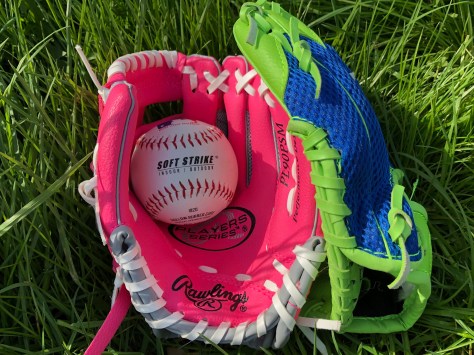
Baseball is back on my mind after decades of absence. Next week Titus and Lydia will start playing Challenger Baseball, a division of our local Little League for children with disabilities. We have been practicing catching, throwing, and batting in anticipation of their first game. The extent of our backyard practice goals is for them to keep their eyes open long enough to see the ball coming toward them in order to catch it rather than be hit by it.
From my teenage years, I have many fond memories of dusty, dirty, spit-filled dugouts. I kept score for our high school baseball and basketball teams and even throughout college. I met my best friends and every guy I ever dated through my years of scorekeeping for baseball and basketball teams and felt as comfortable in dugouts and gymnasiums as anywhere else.
Most anyone familiar with baseball knows that in simple terms, a curveball is a type of pitch in which the pitcher puts a specific spin on the ball in order to make it drop just as it approaches home plate. This is obviously intended to throw the batter off and make the pitch more difficult to hit.
The day after I posted my last blog entry called “Home,” I encountered the first of two significant curveballs in my own life. It happened to be my birthday, and I was anticipating as enjoyable a day as one could hope for when her birthday falls on a Monday. The kids were ready for the day, and Titus and Tess were in Tess’s bedroom building elaborate structures with her large assortment of colorful MegaBlocks when I noticed a small puddle of water on the floor by her feeding pump. Thinking I must have spilled some of her medicine earlier in the morning, I wiped the puddle and went about my morning.
A few minutes later, I re-entered the room only to see the same puddle on the floor. “I thought I wiped that up,” I told myself as I bent down to wipe the water off the floor.
Several minutes later, I again entered the room and saw the same puddle and another smaller one just beside it. Trusting that I was not absentminded or distracted enough to have thought I had already wiped the same puddle three times, I examined the floor more closely and realized that water was coming up from under Tess’s floorboards. A few hours later, I received an extremely undesirable birthday gift: news of a broken pipe under our house that had saturated the insulation, the support beams, and Tess’s brand new floors. Within 24-hours, all of Tess’s belongings were in a storage box on our driveway, two holes were cut in the wall of her room, fans and dehumidifiers were whirring, and Tess’s new floors were torn up.
Recognizing that I had just written about how much my home meant to me, I saw this curveball as an enemy strategy to directly target something I had openly shared to be a source of strength and a gift from the Lord, and I resolved to be unaffected by the strike. But a week later, just as the recovery and restoration process of Tess’s room neared the halfway point, another curveball barreled toward home plate.
I had been anxiously awaiting our March 27 custody and support hearing. Desperate for financial support and binding custody orders, I was eager for the slow-moving wheels of the justice system to speed up. The Saturday night before our Wednesday hearing, as I drove home from having dinner with a friend, I felt the Lord direct me to go to the courthouse. It was already dark, so my rational brain did not think this wise, but the Spirit insisted. Alone and in the dark, I pray-walked around the Chesapeake Juvenile and Domestic Relations Courthouse seven times, each time praying for one of our five minor children and the first and final times, praying for the judge and attorneys and for my own financial situation and strength on trial day. When I drove away, absolute peace overwhelmed me.
Three days later, the evening before our hearing, my attorney called with the unexpected news that our judge had put in retirement papers effective immediately and would not hear our case the next day. A substitute judge would sit on the bench but would likely only hear the support portion of the hearing and continue the custody portion.
I am not proud to say that my immediate reaction to the news was despair. I had already experienced a four-month delay from our last scheduled trial date and had been desperately counting the days until March 27. About two hours into this despair, the Lord chastised me with a clear admonition. He reminded me of my seven-lap prayer walk in which I supposedly relinquished to Him every aspect of this trial and drove away with a complete sense of peace in His sovereignty over the trial and its outcomes.
I knew that the Lord was reminding me that if I truly trusted Him, I would know that He had either allowed or orchestrated this unexpected curveball and that to do anything other than continue to trust Him would be to prove myself either weak in my faith or a liar.
If a batter doesn’t keep her eye on the ball, she will be deceived by an unexpected curve and likely miss the ball altogether or catch the tip of it. I may not have been a ballplayer in my youth, but as the scorekeeper, I knew full well the consequences of both of those responses.
Before this season of loss and rebirth in my own life, I reacted terribly to curveballs. They threw me off course, made me angry, tempted me to blame or lash out at others, stole my joy, or left me in despair. None of those responses reflected trust in the sovereignty of God.
The Apostle Paul faced an extraordinary number of curveballs in his ministry. As I have studied the book of Acts with my Community Bible Study group this year, I have been struck by how many times Paul was seized, accused, beaten, and imprisoned on his three missionary journeys. No matter what he faced, his kept his steady gaze fixated on the Lord, his actions focused on preaching the gospel, his resolve steady, and his heart positioned toward complete trust in Christ.
In his letter to the Romans, Paul wrote, “For we know that the whole creation has been groaning together in the pains of childbirth until now. And not only the creation, but we ourselves, who have the first fruits of the Spirit, groan inwardly as we wait eagerly for adoption as sons, the redemption of our bodies. For in this hope we were saved. Now hope that is seen is not hope. For who hopes for what he sees? But if we hope for what we do not see, we wait for it with patience. Likewise the Spirit helps us in our weakness. For we do not know what to pray for as we ought, but the Spirit himself intercedes for us with groanings too deep for words. And he who searches hearts knows what is the mind of the Spirit, because the Spirit intercedes for the saints according to the will of God. And we know that for those who love God all things work together for good, for those who are called according to his purpose.” (Romans 8:22-28, ESV)
Following Paul’s lead means recognizing the fallen nature of man and creation and all the pain that brings. It also means anticipating redemption of all that is broken and patiently living in hope of that redemption even when we do not see signs of it. It means relying on the Spirit when we feel weak, allowing the Spirit to intercede for us when we do not have the words we need. And it means knowing that He works all things together for good in our lives. Not hoping that but KNOWING it. Not some things but ALL things–even the curveballs.
My two recent curveballs were minor in comparison to others in my own life and those of many who have faced far worse circumstances than I can imagine, but the best thing about experiencing curve balls is the total refocusing they require. An effective curveball will leave a batter more alert, more focused, more intent than she was when it came across the plate and earned her a strike.
Both of my circumstances had favorable outcomes. Tess was out of a bedroom for two weeks and I was out a deductible, but the repairs were made quickly and competently and her room was restored with the unexpected perk of a new paint job that replaced a color I had grown to detest. The substitute judge assigned to our trial forgot to come to court, and though we could have walked out with nothing but a new trial date, our attorneys negotiated temporary agreements that would sustain me until August when our new judge would hear the case.
But in both situations, the best “result” was the reminder that my hope is not in circumstances—whether a house or a judge—but in the God who controls all. My beloved house could fall down around me and the trial could bring negative outcomes, but if my eyes stay focused on Jesus, the “founder and perfecter of my faith,” it won’t matter if I hit a homerun or strike out swinging because He will lead me through either situation with a full knowledge that I cannot comprehend. If He allows or even orchestrates a curve ball, it is because He sees the necessity or benefit of it, and who am I to question that?
I hope the day comes when my first response to life’s curveballs is to turn to the Lord and say, “Wow! I didn’t see that coming, but You did and I trust You. Help me see Your hand in this situation. Show me what to do now.” Until then, I will work on shortening the duration of my “tantrums,” throwing my bat or cap a little closer to the plate, dusting them off a little more quickly, and stepping back into the batter’s box with renewed focus.
“For my thoughts are not your thoughts, neither are your ways my ways, declares the Lord. For as the heavens are higher than the earth, so are my ways higher than your ways and my thoughts than your thoughts. For as the rain and the snow come down from heaven and do not return there but water the earth, making it bring forth and sprout, giving seed to the sower and bread to the eater, so shall my word be that goes out from my mouth; it shall not return to me empty, but it shall accomplish that which I purpose, and shall succeed in the thing for which I sent it. For you shall go out in joy and be led forth in peace; the mountains and the hills before you shall break forth into singing, and all the trees of the field shall clap their hands. Instead of the thorn shall come up the cypress; instead of the brier shall come up the myrtle; and it shall make a name for the Lord, an everlasting sign that shall not be cut off.” (Isaiah 55:8-13, ESV)
 crosseyedliving
I love the metaphors in this!