I squinted uncertainly at the light peering in through my daughter’s window, struggling to clear the fog of a too short sleep. Beneath the fog laid an awareness that I was in that precarious space between. One year had ended just before I fell asleep, and I had awakened to another. As Lucy pushed back the coats of the wardrobe and stepped onto the crunchy snow of Narnia, I greeted 2022 with curiosity: Will you be as bizarre as your two older siblings in the second decade of the 21st century? What unimaginable losses and gains will we tally to you a year from now? Will I graduate this year? Will I find the fortitude to launch another adult child, knowing the crater that will leave in my days? What new barriers will my youngest children break? Will I finally be divorced this year, or will I “celebrate” thirty years of marriage marriage in May? Will this year be a year of healing for the father I am certain I cannot live without? What books will I read, words will I write, songs will I sing off-key? Where will I travel? Who will I meet? Where and how will God meet me?
I am surprised by how comfortable the space between has become. For so long I tried to control it, rush through it, or fight it. It was too uncertain, too anticipatory, too unknown. It is still those things, so it must be me who has changed—or more likely, me who has been changed. In so many ways I have learned to live in a perpetual space between; perhaps that was the only way I could begin to tolerate ambiguity—to learn to trust. For so long, I planted my feet on shifting unstable structures and expected them to hold me up.
I made so many of my life’s greatest mistakes in an effort to squirm out of the discomfort of the space between—so uncomfortable living with heartbreak or loneliness that I was willing to close my eyes and put my fingers in my ears while marching further into unhealthy situations because turning to the right or left—or worse, going backward—seemed unbearable. The toxic familiar becomes deceptively safe.
Some of the spaces between seem unbearably difficult—infertility, a terminal diagnosis, a catastrophic injury. I recently read and was forever changed by the memoir of Anthony Ray Hinton, an innocent man who spent thirty years on death row. In reflecting on a turning point in his unjust, inhumane incarceration, Hinton wrote: “…I realized that the State of Alabama could steal my future and my freedom, but they couldn’t steal my soul or my humanity. And they most certainly couldn’t steal my sense of humor. I missed my family. I missed Lester. But sometimes you have to make family where you find family, or you die in isolation. I wasn’t ready to die. I wasn’t going to make it that easy on them. I was going to find another way to do my time. Whatever time I had left. Everything, I realized, is a choice. And spending your days waiting to die is no way to live” (The Sun Does Shine, p. 118).
Hinton’s situation was truly unimaginable. He lived in a horrifically unjust space between—a space between justice and injustice, between truth and a lie, between imprisonment and freedom—and until the Equal Justice Initiative become involved in his case, he had no tangible hope to leave that space. Even when Bryan Stevenson agreed to represent Hinton, the space between extended for twenty-six more years—far too many. Reading how Hinton used his space between to learn and serve and love and forgive will forever be one of the most inspirational experiences in my life. Hinton made those choices with absolutely no guarantee that his space between would not dissolve into his final space.
Ultimately, isn’t all of life the space between? Not of this world, my heart longs for eternity; however, recognizing this does not mean living in constant limbo or uncertainty, for unlike the space between of the days and years of life, eternity has a seemingly contradictory concreteness about it—being both incomprehensible and utterly safe because the God who promised it is both mystery and certainty.
Sure, there are inherent restrictions in my space between. Until I graduate, I cannot write or teach as a PhD—at least not in any formal capacity. Without the closure of divorce, I cannot seek another relationship—at least not a healthy one in which I have a truly free, truly whole, truly healed self to offer another. I have learned to anticipate those events with an expectancy rather than an urgency—exploring the space between instead of trying to deny it or fill it prematurely.
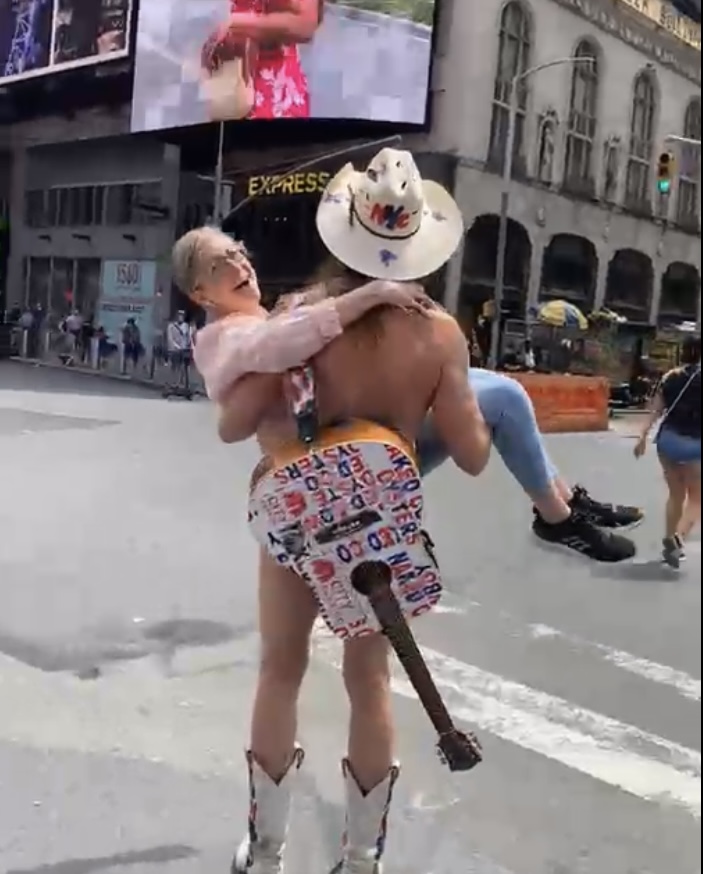
Now it is July and this year is half over—I did celebrate my 30th wedding anniversary with a glorious (and borderline scandalous) trip to New York City in honor of my daughter and her best friend’s high school graduations. I was unexpectedly whisked off my feet by the infamous Naked Cowboy who serenaded me in Times Square with a slightly crass anniversary song. I saw all but one of the original cast members in Hadestown, an incredibly thought-provoking show that is also about the space between, in its own way. And then I came home, got COVID, healed, finished my dissertation, and lost my teaching job for next year due to lack of enrollment in this crazy economy.
So much is still unknown about this year—I might graduate, my divorce might finally be finalized, I might find a new job. Perhaps another cowboy will whisk me off my feet? Beyond that, who knows? When I submitted my complete dissertation draft, a friend asked if I felt light as a feather. I told her “Not yet. I feel like I gave birth to a baby who is in the NICU and I’m not sure how long it will be there.” But that doesn’t scare me like it used to—this space between. It forces me to trust, makes me comfortable with mystery, and keeps me from thinking I am in control—vital components of a life of faith in a God who reveals Himself but not necessarily His plan. The only life for me.
 crosseyedliving