Five days after the murder of George Floyd, I sat by my daughter’s bed in our local children’s hospital, feeling deeply saddened and helpless about the racial division in our country. I shared a list on social media called “Anti-Racism Resources” that stated it was “intended to serve as a resource to white people and parents to deepen our anti-racism work.” Along with the link, I wrote a simple message: “Excellent list of resources for teacher friends, mom friends, and just friends in general. I want to be part of the solution.” A measly offering, I knew, but somehow it felt better than doing and saying nothing.
A Facebook “friend” that I knew only from some shared community activities over the years commented, “Though I agree with the sentiment and the drive to do something helpful, several of the resources listed in this reference have a decided political and polarizing agenda.” I was genuinely puzzled by her comment and simply responded that I appreciated a starting point for resources but trusted everyone to discern for themselves what is useful for their needs and what is not.
She was not reassured and replied with, “It’s your wall and of course you are free to do as you wish [insert happy face emoji]. I am just concerned about the widespread dissemination of anything that may be geared at creating more divisiveness.”
This exchange has stayed with me over the past several years as educational debates have raged across the country. I recently stepped away from a teaching job after being told to avoid “any politically charged issues and topics” in developing a course for teachers working with at-risk learners—a virtual impossibility, considering poverty and race are two predominant causes of a learner being at risk of academic failure. In my home state of Virginia, an executive order was passed “ending the use of inherently divisive concepts, including critical race theory, and restoring excellence in K-12 public education in the Commonwealth.” Florida just banned a new College Board pilot Advanced Placement (AP) course in African American Studies on the grounds that the course is “inexplicably contrary to Florida law and significantly lacks educational value.”
As an English teacher who has taught AP courses for the past five years, the Florida ban astonishes me. AP courses are not mandated; they are chosen by students—typically the most academically advanced students. They are carefully designed courses with rigorous guidelines because they culminate in an exam that provides students an opportunity to earn college credit. The AP courses offered by the College Board reflect an array of subject areas representative of the choices in the general education curriculum of a typical liberal arts college—Calculus, Statistics, Chemistry, Environmental Science, Psychology, Human Geography, Music Theory, European History, Chinese Language and Culture, and Microeconomics are just a sampling of the courses currently offered. A course in African American Studies is a logical addition to the AP course menu.
The statement that such a course “significantly lacks educational value” would be baffling out of the context of our current culture of stupefying political and governmental attempts to silence voices that desperately need to be heard. Ironically, the very act of avoiding “divisive concepts” perpetuates divisiveness more than the inclusion of them ever would. Rather than “protecting” students from divisiveness, these acts fracture our nation, dividing us into those who foster ignorance and those who seek understanding.
As a teacher, I encouraged my students to join academic conversations by articulating their own experiences, beliefs, and opinions and supporting them. When researching an issue, I implored them to go first to primary sources—the letters, speeches, transcripts, and memoirs of participants in whatever historical, scientific, or cultural event they were studying. If participants were silent, I encouraged them to discover why. Were they illiterate? If so, why? Did a disability or lack of access to necessary tools inhibit their ability to communicate their experiences? Did systems exist that silenced or simply did not value their perspectives?
Primary sources are not infallible. History is not definitive. Perspective and context are vital components of every story. The same experience told from multiple viewpoints will always sound different, much as each instrument in an orchestra produces a unique sound and plays a unique part of a movement. Diverse, even contradictory, stories paint a fuller, more detailed picture of an event and while they can never fully capture an experience, they provide a curious individual the opportunity to at least try to understand the event or situation being described. Omitting the most tragic, flawed, disturbing parts of a history deprives a learner not only of the full picture but also of the lessons to be learned, even from failures and atrocities. The authors of the Old Testament books of Judges, the Kings, and the Chronicles clearly knew this.
I, too, once thought that the goal was to ignore difference and pursue unity. But unity doesn’t require sameness or turning a blind eye to difference. The foundation of unity is a common respect for the value of human life—every human life. Understanding as much as possible about the histories and experiences of others is unifying, not divisive. My experience as a white single parent of children with disabilities differs from those of my black friend who parents two young adults, including a son, in a culture where black men are in danger if they are pulled over for a burned-out taillight. They differ from those of a friend who co-parents her son with her fiancé, her ex-husband, and her ex-husband’s husband. They differ from a Sikh family that is torn between the desire to pass on tradition and the risk of sending a turbaned man out into a world of fear and hate. They differ from the men and women who sit on death row either because they made a mistake or because someone else did and they were falsely imprisoned for it. They differ from a child who grows up in a neighborhood where drugs are easier to get than food. They differ from my own child whose brain suffered so much damage at birth that she struggles to see, to eat, and to move her body in the simplest of ways. I will never fully comprehend any more than someone else could fully grasp my lived experience, but every story I hear or read expands my capacity for empathy and my sense of unity to the people in our beautifully diverse nation.
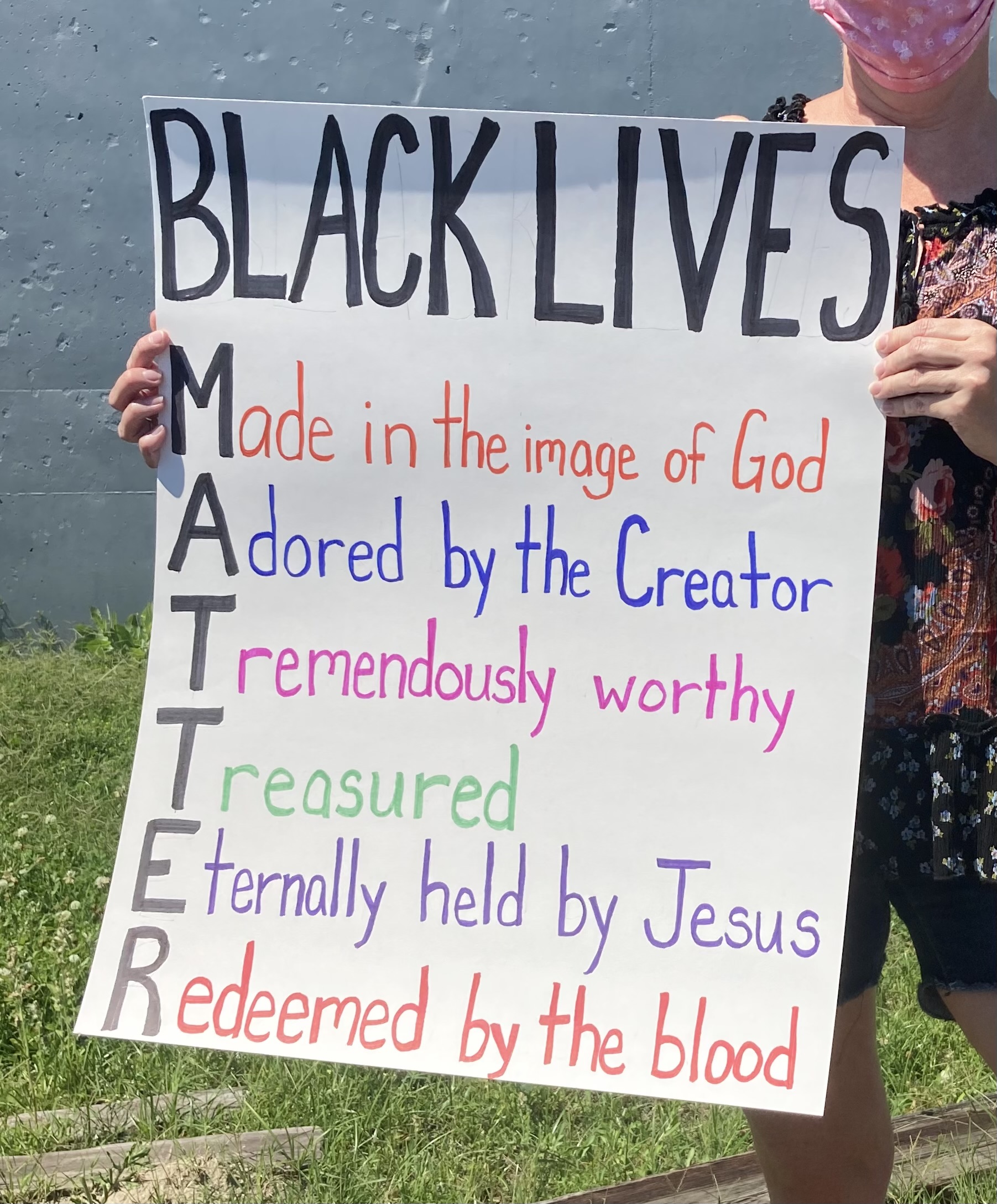
My own journey to understand more about racial justice has shown me both the impossibility of truly understanding and the necessity of never ceasing my efforts to do so. In the weeks after George Floyd’s murder, I had the opportunity to participate in a prayer march with members of my church. I have never felt more truly a part of the body of Christ than I did marching through the streets of Norfolk, Virginia, with my Black Lives Matter sign. But I was also taken to school that day. Listening to community leaders speak about specifics of systemic racism in our community opened my eyes to how very little I know about how we got to where we are today. I am an educated person. I am a teacher. I have had many black friends through all stages of my life. I admire numerous black heroes in our nation. I took college courses on African American literature and have included works by Frederick Douglass, Martin Luther King, Jr., James Baldwin, Malcolm X, Maya Angelou, Bryan Stevenson, and many other black writers in my English courses for years. I thought, at the very least, I was not part of the problem. But after listening to speaker after speaker at that prayer march, I realized how incredibly ignorant I have been to the depths and sources and consequences of the racial disparities in our nation and how complicit I am in them.
Since that June day in 2020, I have read and listened voraciously, trying to learn what my education failed to teach me. I have been a student of Anthony Ray Hinton, Jr., Esau McCaulley, Wes Moore, Ian Manuel, Austin Channing Brown, Brandon P. Fleming, Howard Thurman, Nikole-Hannah Jones, Danté Stewart, Ibram X. Kendi, Cole Arthur Riley, and Derrick Bell. My bookshelves overflow with the stories and perspectives that will teach me next. Everything I read or hear simultaneously helps me understand more and highlights the fact that I can never truly understand. It exposes not only my ignorance but also my illusions of innocence. As long as the problem of racial injustice exists, we are all part of the problem. Every story I hear has expanded both my understanding of the “faces at the bottom of the well” and my desire to join their ascent, however hopeless it sometimes feels.
The idea that a course in African American Studies “significantly lacks educational value” is ludicrous. It would be valuable for every American citizen to take that course—and a course on every other marginalized people group in our country for that matter. We all need MORE understanding, not less. The word educate is derived from the Latin root educat (led out). To educate is to lead someone out of ignorance, not by deciding what they should know or believe but by equipping them to be critical thinkers who are capable of reading multiple perspectives, discerning their own understanding and beliefs, and then adding their voice to the conversation—the conversation of a diverse nation united by its mutual respect for the people that comprise it. The thought of any individual seeking to hinder another individual’s access to specific perspectives and stories defies the very purpose of education. It is an act rooted in ignorance and fear. It is the epitome of the very divisiveness it seeks to eradicate.
 crosseyedliving