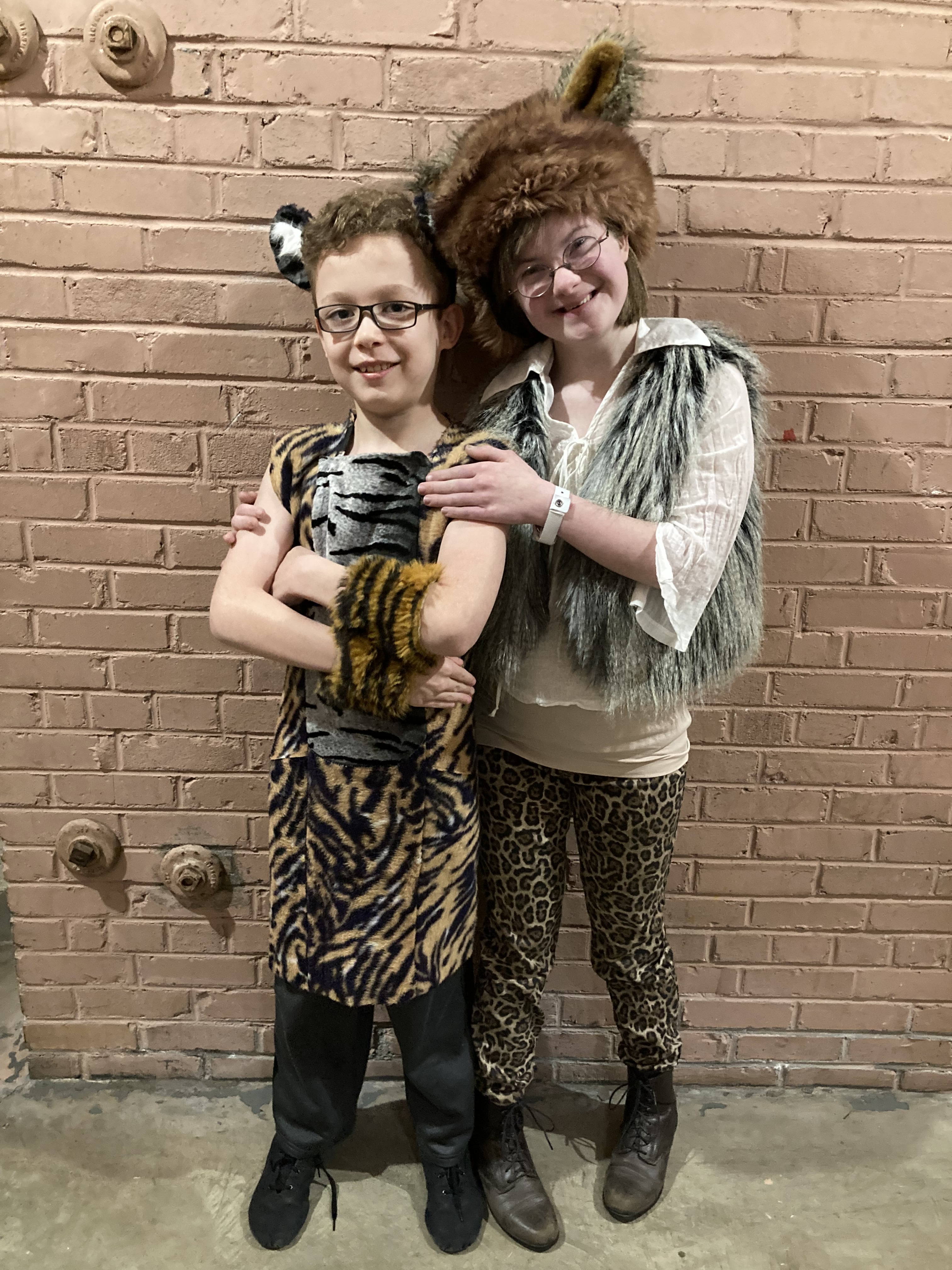
In April 2015, I attended Seussical, the first performance of the Arts Inclusion Company (AIC), which defines itself as a “company where people of All Abilities are welcomed to participate in all aspects of theatrical arts.” I described the experience as “a glimpse of the Kingdom on earth—a portrait of how life could be if we all risked putting our individually broken selves together to create something much more complete and meaningful than we are capable of alone.” I knew that night that when Lydia and the twins were old enough, we would join AIC. A few life interruptions and a global pandemic later, we did just that!
What I witnessed from my seat in the audience was just a taste of what we experienced as participants. From the first rehearsal to the final curtain call and every moment in between, the kids and I felt welcomed, valued, safe, and accepted. Watching the show come together over three months gave me a picture of what we can create when ego and competition and perfection are not just subdued but entirely absent.
Of all the many positive effects Lydia’s birth has had on my life, one has stood out from her very first year of life. I realized almost immediately that having a child with Down syndrome changed the way the world saw our family. Though it manifested in different ways, it was tangible. In the eyes of friends, family, and strangers, we forever lost all possibility of being a “picture-perfect family” in image and in substance. Some looked at us with pity, others with discomfort. Many just looked away altogether. Those with personal experience looked at us with understanding and joy. Some with no experience were at least curious and willing to join us on our unexpected journey.
That lost possibility for perfection transformed my life from one of pressure I did not even recognize to one of freedom. Through my children’s “dis”-abilities, I found an entirely new way to exist—one free of pressure, expectation, timelines, perfection, and pride. As Lydia grew, and with her my exposure to and appreciation for a world of people I had previously scarcely acknowledged, I began to question the dis- in disability. I would say, half joking, that perhaps it was those of us who lacked the third copy of the 21st chromosome that were actually disabled, since Lydia’s perspective and capacity for love seemed far more Christlike than most people I knew. Lennard J. Davis later gave me the academic explanation for my instinctive insight in his discussion of normalcy as a construct. Davis wrote that “the ‘problem’ is not the person with disabilities; the problem is the way that normalcy is constructed to create the ‘problem’ of the disabled person.” My transformation from a world that viewed imperfection as a problem to be avoided to one of freedom from pressure carried me through even greater “imperfections” that our family would face in the years to come.
Living free in a world dominated by pressure and expectation, however, can be very isolating and lonely at times. Society doesn’t place much value on imperfection and doesn’t know what to do with families like ours. As an (almost) single mom in communities where divorce is taboo and with only children with special needs remaining in the home, I am often the person everyone smiles at and waves to—but from afar. In an interview, Kate Bowler once shared that a common lament of individuals who have had “a big before and an after in their life” is that, “I’m everybody’s inspiration but nobody’s friend.” Being a part of AIC’s production of Peter Pan was like entering a world filled with people who live in the freedom of imperfection—a world of instant friends for me and my children. It felt like going home.
J.M. Barrie created the world of Neverland in his 1911 novel originally titled Peter and Wendy. He described the Neverlands as an invention of a child’s mind, which “keeps going round all the time,” but is “always more or less an island, with splashes of color here and there.” Barrie acknowledges that “the Neverlands vary a good deal,” with one child’s differing from another’s, but “on the whole the Neverlands have a family resemblance” and are close enough to one another to facilitate grand adventures. Neverland is a boundary-free place where limitations of reality are suspended and belief abounds. Anything is possible with a little fairy dust…even flying.
The research I conducted for my dissertation was based on the work of a psychologist named Reuven Feuerstein who believed no individual was without hope or the propensity to change. When I discovered his work, I devoured everything I could read from this man who saw potential of those society often discounted and even discarded, long before neuroscience scientifically validated his work. Feuerstein said that children with neurodevelopmental disorders such as Down syndrome can be helped and that “chromosomes do not have the last word.”
My life’s work has been to parent and educate all of my children in a way that left the world open for them to pursue whatever gifts, passions, interests, or callings God placed in their hearts. For my children who don’t fit society’s image of perfection, that has included protecting them from anyone and anything that makes them feel “less than.”
During the adventures of the Darling children in Peter Pan, Tinkerbell protects Peter by drinking his poisoned medicine. As she lays dying, Peter is only able to save her by calling on those around him to believe in fairies. From the earliest rehearsals to the final matinee, that scene resonated with me on so many levels. To live in this world, and especially to fly in it, my children need belief—belief in themselves that is protected and fanned like a flame by those around them. Sadly most spaces seek, whether deliberately or unintentionally, to extinguish that flame of belief.
Our past few months being a part of AIC allowed us to spend time in a real-world Neverland, where limitations of reality are suspended and belief abounds. I saw all ages, all races, all genders, all types of abilities come together to pool their gifts, talents, and passions to create something beautiful to offer to the world. Everything was accepted and welcomed—all that was required was a willingness to show up. Expectation, judgment, pressure, and perfection were absent. Friendship was granted simply by presence. No explanations or apologies were needed. The experience was beautiful and like Peter, I never wanted to leave.
But the final curtain closed and we returned to our everyday lives in a world that sees more limitations than possibilities—a world that doesn’t know what to do with our imperfections and brokenness. But because we know that we are not as alone as it sometimes feels, we will keep venturing out into that world so that it can begin to see all the beauty that can come from brokenness–and maybe change its understanding of “normalcy” in the process. Like Wendy, we will return to Neverland every year we are able—for a little spring cleaning and a lot of adventure. And we will keep our dreams alive in the meantime—fueled by belief…and perhaps a little fairy dust.
 crosseyedliving