According to his biographer, Charles Dickens “thought of A Christmas Carol as a way to, ‘help open the hearts of the prosperous and powerful towards the poor and powerless….’” He first intended to write a pamphlet that would be called “An Appeal to the People of England on behalf of the Poor Man’s Child,” but after thinking about it for less than a week, he “decided instead to embody his arguments in a story, with a main character of pitiable depth.” By putting faces on societal issues through relatable characters such as Bob Cratchit, Tiny Tim, and the infamous Ebenezer Scrooge, Dickens enabled audiences to truly see and begin to understand the messages he wanted them to hear, messages that remain incredibly relevant today.
For the past ten weeks, a Hampton Roads company of actors and actresses have gathered for hours every Saturday and on various days throughout the week, rehearsing to bring Dickens’ story to life. Arts Inclusion Company (AIC) is “a theater community where all are ABLE.” AIC utilized Dickens’ memorable characters portrayed by incredible actors and actresses to convey its own message that indeed we are ALL able and deserve to be seen.
When AIC announced auditions for A Christmas Carol, I was one of the first to sign my kids up. I had eagerly awaited our return to “Neverland,” and was excited for Tess to have the chance to participate this year. Lydia prepared a rendition of “I Love Trash” by Oscar the Grouch, complete with a prop, but was too shy to perform it in the audition. Titus, who has a self-described “short memory,” forgot the lyrics he was going to sing and ended up dancing for his audition. Tess sang the only song she had yet sung on her own from memory—“Happy Birthday.”
After Scrooge observes the home and family of his employee Bob Cratchit, he is baffled by the fact that “They have so little and yet they rejoice.” Christmas Present responds, “They have infinitely more than you observe, Ebenezer Scrooge. They have each other. The world is full of people like these, man. It is only that you have never lifted up your eyes to see. See them now…”
Each offering made by my kids and all the others who auditioned that day was more than enough because the AIC Board members and volunteers have mastered the lesson Scrooge learned through his Christmas Eve encounters with the ghosts. They are able to see “infinitely more” than can be observed.
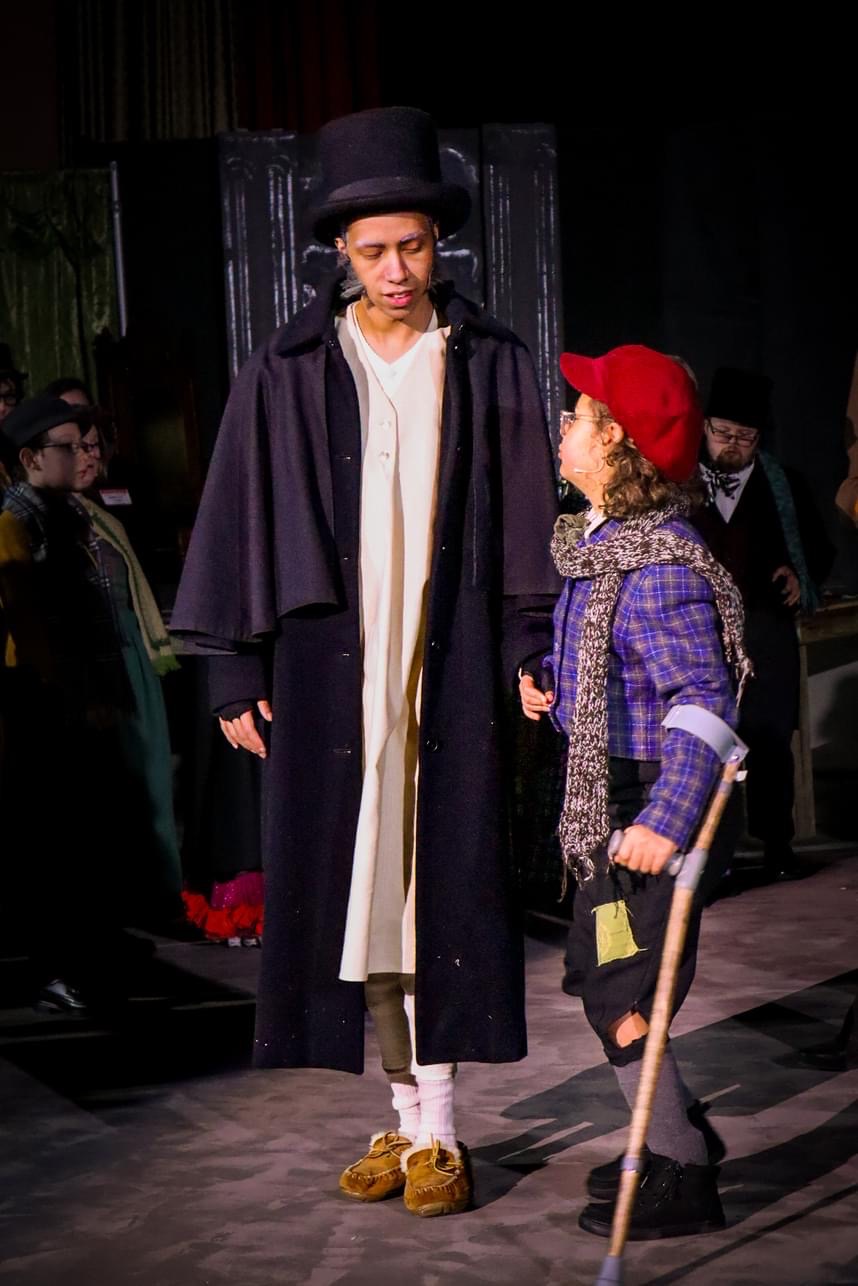
When the cast list came out, Tess, who first started speaking about five years ago, ate her first food by mouth three years ago, just began drinking water by mouth in May of this year, and had only recently sung “Happy Birthday” from memory was cast in the role of Tiny Tim.
In early 2020, I was asked to share Tess’s story as part of a video series our church was doing on Miracles. The turnaround time was short, so I quickly sifted through six and a half years of photographs and video clips that my son Jonah and I compiled into a video the church could show on Sunday morning. At the very end of that video is footage of the first time Tess walked with a little lofstrand crutch her physical therapist thought we should try. I called it one of the “thousand little miracles” that had comprised Tess’s first six and a half years of life.
Three and a half years and a thousand more miracles later, I accepted Tess’s role as Tiny Tim in AIC’s production with faith that God would equip her to fulfill it. I could never have imagined how very perfectly suited she would be for the part and how much she would embrace it. Watching Tess deliver her lines and sing her songs with the same infectious laugh I described in the Miracles video, and seeing her walk to the front of the stage with her lofstrand crutch at the end of the show holding the hand of, not an attendant or family member, but a fellow actor—another overcomer—was an experience for which I do not have words.
By the end of A Christmas Carol, Ebenezer Scrooge has learned the lesson the Ghost of Christmas Present set out to teach him: “A man may have nothing in this world but he can make it a paradise by the way he lives his life. You have it all before you and go about with your eyes cast to the ground. Look up, Ebenezer, look up.” With eyes to see, Scrooge transformed into “as good a friend, as good a master, and as good a man as the good old City knew,” a man whose “own heart laughed,” and a man who “knew how to keep Christmas well.”
I have been privileged to watch Tess transform from a premature infant whose MRI images evoked either doom-and-gloom prognoses or intolerable pity to a walking, (constantly) talking, singing, sibling-annoying, joy-filled child who has gifts to nurture, purposes to fulfill, and hearts to touch. All because select doctors, therapists, attendants, friends, and family chose to see “infinitely more” in her than could be observed.
Dickens concluded his novella with a blessing, “And so, as Tiny Tim observed, God bless Us, Every One!” As often happens with powerful, meaningful words like love, hate, or truth, our modern society has conscripted the word “bless” and twisted into something that varies from religious speak (#blessed) to Southern falsity (“bless her heart”) and everything in between. Being blessed has come to represent success, material wealth, status, health, and perfect relationships. But the actual meaning of bless is “to ask God to look upon with favor.” Not a party favor or a favor from a friend, but “approval, support, and a kindness that is beyond what is expected.”
Each performer in AIC’s production has a story that includes countless people who could see “infinitely more” than they observed. I hope that every audience member who witnessed Tess’s performance this weekend and the performance of each and every actor and actress who shared the stage with her for these past ten weeks now has the eyes to see that ALL are able and deserve to be seen.
And as the very ABLE Tess (in the role of Tiny Tim) observed, “God bless Us, Every One!”
Photo Credit: Suzette Valentine (mom of Scrooge)
 crosseyedliving