At the Heart of It All

I had a meeting this spring with an engaging, intelligent young woman who is doing some of the most meaningful work I can imagine for some of the most overlooked people in our local community. We shared experiences, passions, and ideas for how I can contribute to the work of the non-profit organization she serves. We discussed writing, research, teaching, and storytelling and how I can use them to make a difference. Toward the end of the meeting, she said words like these to me: “I can see that at your very core—at the heart of it all—you are a mother. When you write about or share your experiences, you are mothering all of us who read or hear them.” 

It was one of those life-giving, truth-telling moments that you know you will always remember because something inside you shifts and your view is forever changed. Her words affirmed one of the central lessons of my last seven years that had been percolating in me but that I had not previously been able to articulate: After two decades of believing that my mother-self and my other-self were in conflict, I have finally realized that we are one.

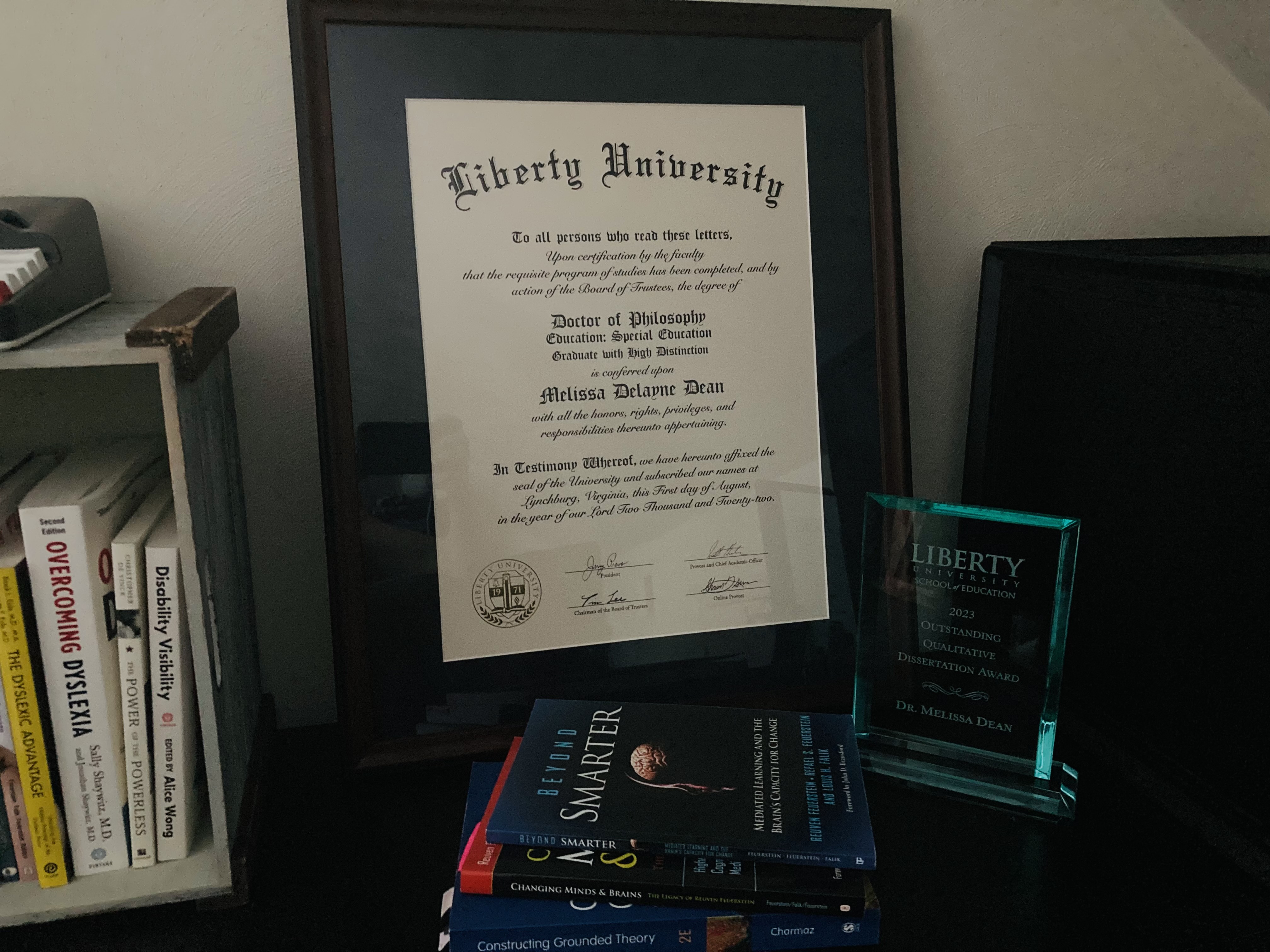
I graduated this spring. Well, technically, I graduated last August, but the ceremony was in May. The timing and expense of the ceremony made it a bit challenging so I chose not to attend and didn’t give it much thought once the decision was made, until…

Shortly after 10 on the Thursday morning of my commissioning ceremony, as I was running errands and about to drive to a haircut appointment, I received an unexpected text from my dissertation chair: “Melissa!!! You just won the qualitative dissertation award!!!!!!” I was stunned. And honored. And a little sad that I wasn’t there to receive it in person. But as the day went on and I shared the news with my family and processed it a bit more, the significance began to register. This was more than just an unexpected accolade to me; it was an external affirmation of a series of choices I had made over the years I spent pursuing that degree…a journey that ended far differently than it began.

I have always valued education. My mom encouraged it in every way, and my dad frequently told me that there were two things in life that no one could take away from me—my education and my self-respect—so I knew it would be wise to have as much as possible of both. Attending college wasn’t a decision I made but an assumption I lived out. And as a lifelong Tar Heel basketball fan, the choice of school was as well. 

Two years after graduating from college and getting married, the military sent my husband to the University of Michigan for a grad school tour. After a four-year long-distance relationship/engagement and two-years of ship deployments, it sounded heavenly to attend grad school together, so I applied to get my master’s degree in English Education at the same time. Surprised by a research assistantship opportunity that I literally stumbled upon in the U-M School of Education women’s bathroom within a week of our move to Ann Arbor, the doors opened for me to pursue basically all the education I wanted while serving in that RA role. By the next spring, I had completed the master’s degree I had originally sought, so the professor I worked with highly encouraged to enter Michigan’s Ph.D. program. The project we were working on had enough data to fuel numerous dissertations, making the opportunity especially appealing. As much as I wanted to apply, I knew my husband would be transferred to Washington, D.C. for a payback tour as soon as he graduated the following spring. It is impossible to complete a Ph.D. in a year and virtual learning did not exist in 1995, so starting the degree and finishing it from afar would have been nearly impossible. I didn’t want a second master’s degree, so I petitioned the Dean to allow me to pursue U-M’s defunct Educational Specialist (Ed.S.) degree, which was basically the coursework of a Ph.D. that culminated in a major paper approved by a committee but not a dissertation based on original research. 

I learned I was pregnant with our first child just weeks after beginning that degree, so I chose to transition from being a research assistant, which required a good bit of travel, to being a teaching assistant. Pregnancy and the Ed.S. coursework coexisted nicely. Even writing the draft of my Ed.S. paper was manageable. My daughter arrived the day after her due date (and my birthday)—six weeks before the end of the semester, her dad’s and my graduation ceremonies, and our move to DC. I couldn’t afford to miss a class and still finish on time, so I took my postpartum donut to class with me, nursed her in my little grad student office between classes, and sat on the floor of my chair’s office calming my colicky baby while discussing the paper revisions necessary to appease the requests of my other committee members. I recall one of the members suggesting I take an incomplete and finish the paper over the summer, but I knew that would never happen. Those weeks were a blur of exhaustion, crying, leaking milk, healing, and doggedly staying the course. Somehow, I finished.

I joked later that I promptly hung both graduate degrees over my daughter’s changing table. As a military spouse, I was at the mercy of my husband’s career demands. Over the subsequent twenty years, I pursued as much work as I could manage—teaching night school, writing for newspapers, editing, and eventually designing courses and teaching online—with promises that “my turn would come.” I hoped to finish that Ph.D. someday and teach at a university and perhaps one day become an author. That day always got pushed into the future…after this, after that…until eventually I couldn’t see it anymore.

Twenty-five years after graduating from U-M, I began applying to doctoral programs while taking the necessary steps to move into a home on my own. To those who don’t know me well, this seemed foolish, but to those who do, it made all the sense in the world. Reading, writing, books, words, ideas, discussions, learning…are what make my heart sing. They are how I process the world. My therapist asked how I would manage the workload with all of the stress and responsibility that was now upon me as a single parent. “School is therapy to me,” I told her, and it truly was.

I assumed my Ph.D. should be in English Education or Curriculum Development, the two fields I had previously studied and acquired the most experience in during my patchwork career. A year into English coursework, however, an external battle prompted me to change direction. I had homeschooled our children for fifteen years with the full support of my spouse, but suddenly that choice was under attack. I made a phone call that changed everything. 

In my conversation with the head of Liberty’s Special Education department, I inquired about the logistics of switching my degree program, knowing that having a terminal degree in the field would end any future conversation about my capacity to homeschool children with special needs. What I didn’t realize at the time was that I was also marrying my professional and parenting lives in a way that would benefit me and the children for years to come. I was also forming a relationship with an incredible professor who would become my mentor and eventually my dissertation chair.

The journey from that conversation to last year was both challenging and invigorating. I loved being a student of a field that so directly affected my own children, and I was exposed to theories that completely revolutionized my views of education, teaching, parenting, and the potential of all learners. Completing my coursework and entering the dissertation stage was simultaneously exhilarating and terrifying. Choosing a topic, however, was simple for me. I knew that even though it would attract no attention in my field, I wanted to study families who chose to homeschool learners with special educational needs and disabilities—families just like mine.

The dissertation road is never smooth—approval delays, finding participants, interviewing, transcribing, and coding are all part of an arduous and very non-linear journey, much of which is completely out of the researcher’s control. I had hoped to graduate in the spring of 2022 but that extended into summer. My dad had been diagnosed with cancer and expressed his desire to see me graduate before he lost the battle he faced. On a mission to grant his desire, I resigned myself to the idea that “done is better than perfect.” But when I started to analyze the data and write Chapters 4 and 5, I quickly realized that I couldn’t tell my participants’ stories any other way than with the justice they deserved. My participants were me, their children were my children, and their voices deserved to be heard.

I submitted my final draft, defended in July 2022, and technically graduated that August. Even though I wasn’t there to receive it, learning that of all the qualitative dissertations submitted in Liberty’s Education Department for the 2022-2023 school year, mine was chosen for distinction overwhelmed me with gratitude, not so much for the award but for the affirmation of all the little choices that led to it:  the choice to postpone the degree for over two decades; the choice to homeschool; the choice to adopt children with special needs; the choice to enter a new field at the highest level during a time of such intense personal stress and transition; the choice to study a low-profile, marginalized population that means the world to me but offers no professional currency; and the choice to finish strong instead of just finishing. 

Outsiders may not realize how remarkable it is for a dissertation about homeschooling learners with special educational needs and disabilities written by a single mom over fifty to be recognized but I know, and it overwhelms me with gratitude and affirmation. I could not have produced that research and its resulting model apart from the choices I made and the experiences I had in the years that have passed since I drove away from Ann Arbor, Michigan in 1996, leaving so much behind.

So now my degree hangs in my guest room office where I work at odd hours of the day and night for a local non-profit doing what I expect to be incredibly meaningful work in service of things that truly matter to me. My primary job is and will continue to be that of mother and teacher to my kids, but I now see how inseparable that is from everything I am and how much better it makes me at anything I choose to do. My mother-self and my other-self are truly one, and I finally realize—and celebrate—the value of that marriage.
Divided We Stand

Five days after the murder of George Floyd, I sat by my daughter’s bed in our local children’s hospital, feeling deeply saddened and helpless about the racial division in our country. I shared a list on social media called “Anti-Racism Resources” that stated it was “intended to serve as a resource to white people and parents to deepen our anti-racism work.” Along with the link, I wrote a simple message: “Excellent list of resources for teacher friends, mom friends, and just friends in general. I want to be part of the solution.” A measly offering, I knew, but somehow it felt better than doing and saying nothing.

A Facebook “friend” that I knew only from some shared community activities over the years commented, “Though I agree with the sentiment and the drive to do something helpful, several of the resources listed in this reference have a decided political and polarizing agenda.” I was genuinely puzzled by her comment and simply responded that I appreciated a starting point for resources but trusted everyone to discern for themselves what is useful for their needs and what is not. 

She was not reassured and replied with, “It’s your wall and of course you are free to do as you wish [insert happy face emoji]. I am just concerned about the widespread dissemination of anything that may be geared at creating more divisiveness.”

This exchange has stayed with me over the past several years as educational debates have raged across the country. I recently stepped away from a teaching job after being told to avoid “any politically charged issues and topics” in developing a course for teachers working with at-risk learners—a virtual impossibility, considering poverty and race are two predominant causes of a learner being at risk of academic failure. In my home state of Virginia, an executive order was passed “ending the use of inherently divisive concepts, including critical race theory, and restoring excellence in K-12 public education in the Commonwealth.” Florida just banned a new College Board pilot Advanced Placement (AP) course in African American Studies on the grounds that the course is “inexplicably contrary to Florida law and significantly lacks educational value.” 

As an English teacher who has taught AP courses for the past five years, the Florida ban astonishes me. AP courses are not mandated; they are chosen by students—typically the most academically advanced students. They are carefully designed courses with rigorous guidelines because they culminate in an exam that provides students an opportunity to earn college credit. The AP courses offered by the College Board reflect an array of subject areas representative of the choices in the general education curriculum of a typical liberal arts college—Calculus, Statistics, Chemistry, Environmental Science, Psychology, Human Geography, Music Theory, European History, Chinese Language and Culture, and Microeconomics are just a sampling of the courses currently offered. A course in African American Studies is a logical addition to the AP course menu.

The statement that such a course “significantly lacks educational value” would be baffling out of the context of our current culture of stupefying political and governmental attempts to silence voices that desperately need to be heard. Ironically, the very act of avoiding “divisive concepts” perpetuates divisiveness more than the inclusion of them ever would. Rather than “protecting” students from divisiveness, these acts fracture our nation, dividing us into those who foster ignorance and those who seek understanding.

As a teacher, I encouraged my students to join academic conversations by articulating their own experiences, beliefs, and opinions and supporting them. When researching an issue, I implored them to go first to primary sources—the letters, speeches, transcripts, and memoirs of participants in whatever historical, scientific, or cultural event they were studying. If participants were silent, I encouraged them to discover why. Were they illiterate? If so, why? Did a disability or lack of access to necessary tools inhibit their ability to communicate their experiences? Did systems exist that silenced or simply did not value their perspectives? 

Primary sources are not infallible. History is not definitive. Perspective and context are vital components of every story. The same experience told from multiple viewpoints will always sound different, much as each instrument in an orchestra produces a unique sound and plays a unique part of a movement. Diverse, even contradictory, stories paint a fuller, more detailed picture of an event and while they can never fully capture an experience, they provide a curious individual the opportunity to at least try to understand the event or situation being described. Omitting the most tragic, flawed, disturbing parts of a history deprives a learner not only of the full picture but also of the lessons to be learned, even from failures and atrocities. The authors of the Old Testament books of Judges, the Kings, and the Chronicles clearly knew this.

I, too, once thought that the goal was to ignore difference and pursue unity. But unity doesn’t require sameness or turning a blind eye to difference. The foundation of unity is a common respect for the value of human life—every human life. Understanding as much as possible about the histories and experiences of others is unifying, not divisive. My experience as a white single parent of children with disabilities differs from those of my black friend who parents two young adults, including a son, in a culture where black men are in danger if they are pulled over for a burned-out taillight. They differ from those of a friend who co-parents her son with her fiancé, her ex-husband, and her ex-husband’s husband. They differ from a Sikh family that is torn between the desire to pass on tradition and the risk of sending a turbaned man out into a world of fear and hate. They differ from the men and women who sit on death row either because they made a mistake or because someone else did and they were falsely imprisoned for it. They differ from a child who grows up in a neighborhood where drugs are easier to get than food. They differ from my own child whose brain suffered so much damage at birth that she struggles to see, to eat, and to move her body in the simplest of ways. I will never fully comprehend any more than someone else could fully grasp my lived experience, but every story I hear or read expands my capacity for empathy and my sense of unity to the people in our beautifully diverse nation. 

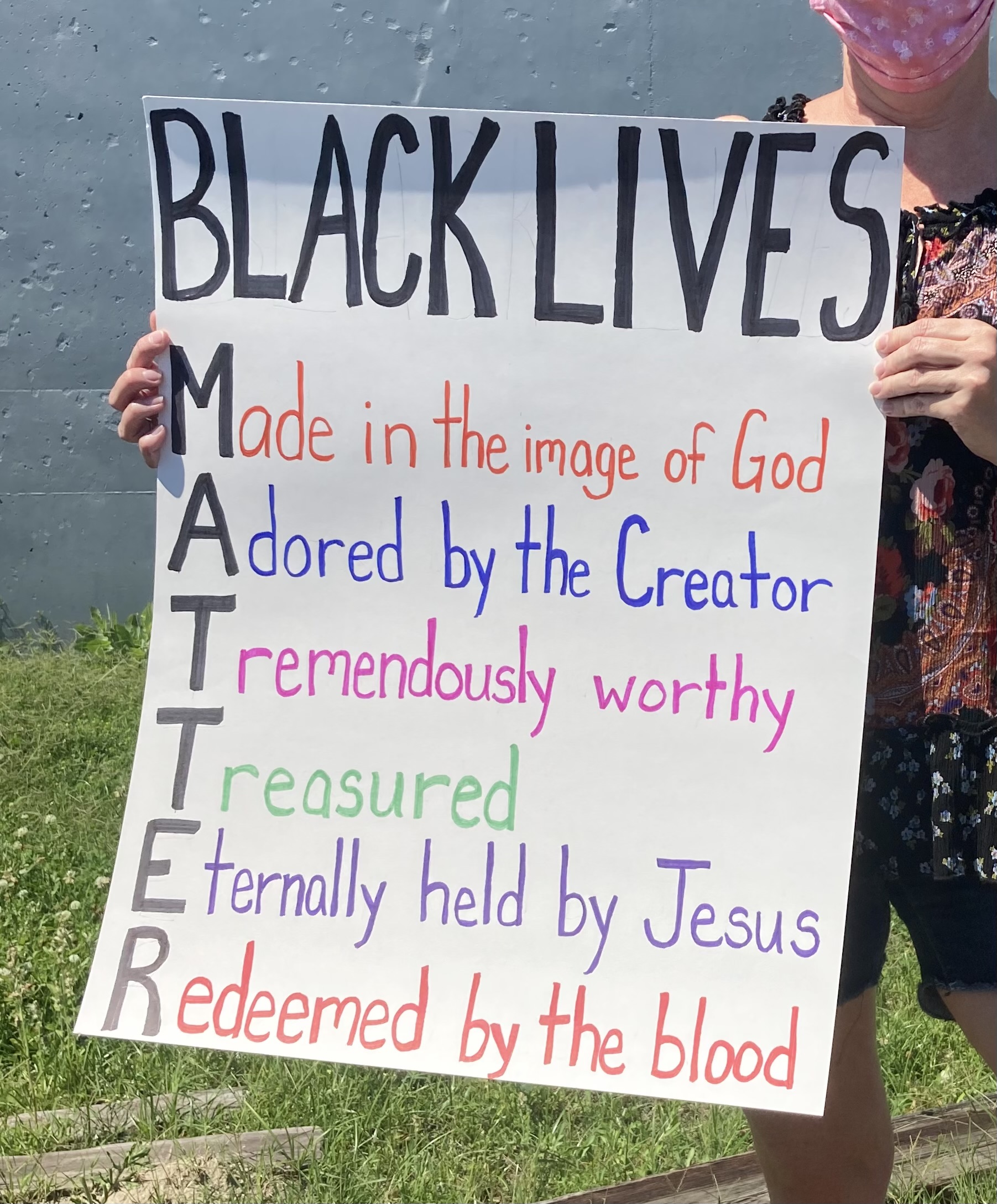
My own journey to understand more about racial justice has shown me both the impossibility of truly understanding and the necessity of never ceasing my efforts to do so. In the weeks after George Floyd’s murder, I had the opportunity to participate in a prayer march with members of my church. I have never felt more truly a part of the body of Christ than I did marching through the streets of Norfolk, Virginia, with my Black Lives Matter sign. But I was also taken to school that day. Listening to community leaders speak about specifics of systemic racism in our community opened my eyes to how very little I know about how we got to where we are today. I am an educated person. I am a teacher. I have had many black friends through all stages of my life. I admire numerous black heroes in our nation. I took college courses on African American literature and have included works by Frederick Douglass, Martin Luther King, Jr., James Baldwin, Malcolm X, Maya Angelou, Bryan Stevenson, and many other black writers in my English courses for years. I thought, at the very least, I was not part of the problem. But after listening to speaker after speaker at that prayer march, I realized how incredibly ignorant I have been to the depths and sources and consequences of the racial disparities in our nation and how complicit I am in them.

Since that June day in 2020, I have read and listened voraciously, trying to learn what my education failed to teach me. I have been a student of Anthony Ray Hinton, Jr., Esau McCaulley, Wes Moore, Ian Manuel, Austin Channing Brown, Brandon P. Fleming, Howard Thurman, Nikole-Hannah Jones, Danté Stewart, Ibram X. Kendi, Cole Arthur Riley, and Derrick Bell. My bookshelves overflow with the stories and perspectives that will teach me next. Everything I read or hear simultaneously helps me understand more and highlights the fact that I can never truly understand. It exposes not only my ignorance but also my illusions of innocence. As long as the problem of racial injustice exists, we are all part of the problem. Every story I hear has expanded both my understanding of the “faces at the bottom of the well” and my desire to join their ascent, however hopeless it sometimes feels. 

The idea that a course in African American Studies “significantly lacks educational value” is ludicrous. It would be valuable for every American citizen to take that course—and a course on every other marginalized people group in our country for that matter. We all need MORE understanding, not less. The word educate is derived from the Latin root educat (led out). To educate is to lead someone out of ignorance, not by deciding what they should know or believe but by equipping them to be critical thinkers who are capable of reading multiple perspectives, discerning their own understanding and beliefs, and then adding their voice to the conversation—the conversation of a diverse nation united by its mutual respect for the people that comprise it. The thought of any individual seeking to hinder another individual’s access to specific perspectives and stories defies the very purpose of education. It is an act rooted in ignorance and fear. It is the epitome of the very divisiveness it seeks to eradicate.

Time to Scream Back

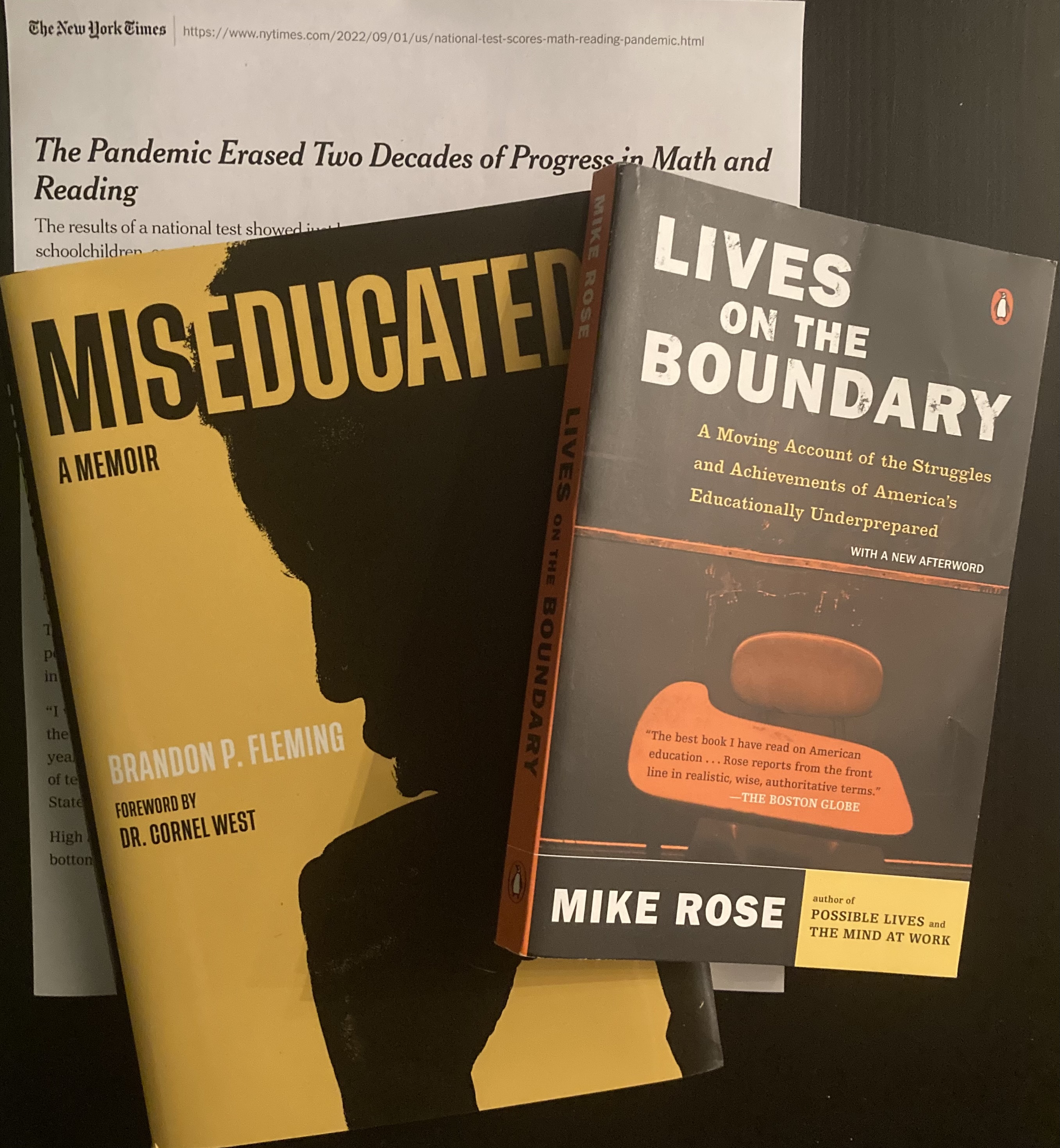
The New York Times headline that splashed across our devices three weeks ago screamed The Pandemic Erased Two Decades of Progress in Math and Reading. It’s time for American educators to scream back.

Did the pandemic erase two decades of progress? No. Did it harm our youth in a myriad of ways? Yes. But the data that prompted the screaming headlines don’t capture the harm. They capture the results of a national sample of nine-year-olds on a standardized test. Once again, a snapshot from an isolated instrument is used to make a broad statement about systems and individuals, neither of which it can remotely encapsulate. The broken state of education in our nation goes much deeper than a standardized test can possibly depict, just as the learning potential of the student taking that test is so much more than it can possibly portray. 

I have been an educator since the day I knew what one was—from the tiny schoolroom my parents let me create in our spare bedroom to teach my animate and inanimate pupils (aka my brother, my grandmother, and my stuffed animals) to a wide variety of classrooms over the past thirty years, ranging from a rural high school in North Carolina to an inner city junior high in Florida to a graduate classroom in Michigan to an alternative high school in northern Virginia. I have taught online, in people’s homes, in church classrooms, and on my living room couch. I have worked with AP students who earned perfect scores on the SAT and students who have “no measurable IQ.” The study and practice of education has been my life’s work. 

And that headline makes me want to scream. 

The alarm sounded by the “nation’s report card” will be received as the educational equivalent of a six-alarm fire to which all available personnel should respond. But if the response is federal policies crafted by polarized politicians to pour funding and programs onto the fires of our educational system that will be deemed successful when the standardized test scores of nine-year-olds rise from the ashes and show that pandemic losses have been regained, nothing will have changed. 

American educators, it is time for us to scream back at the headlines. If you interact with a child in our nation, you ARE an American educator. Our global, interconnected, fast-paced world is the classroom of our nation’s youth, and the most educationally valuable moments of a child’s day are any in which he or she is engaged in everyday life with another human being. Our children’s education IS in crisis, but the problems are much bigger than a standardized test can possibly capture. Our youth live technology-saturated lives and face unbelievable risks of violence, addiction, and abuse. Our teachers have an innate passion for teaching and a love of young people but have been shackled for years by standards, tests, policies, and paperwork. Parents are overwhelmed, overworked, and under-supported in their day-to-day lives. And our leaders are embroiled in an unbelievable national display of pervasive, ego-driven polarization in which everyone loses.

Almost thirty years ago as an eager graduate student in the University of Michigan’s School of Education, I devoured the words of Mike Rose in his autobiography Lives on the Boundary. As Rose reflected, his story “makes particular and palpable the feeling of struggling in school, of not getting it, of feeling out of place” but also conveys “an overall narrative of possibility, possibility actualized through one’s own perseverance and wit, yes, but also through certain kinds of instruction and assumptions about cognition, through meaningful relationships with adults, through a particular set of understandings about learning and the relationship of learning to one’s circumstances” (p. 247). His work guided and inspired my classrooms for years to follow.

A few weeks ago as I drove to visit my father, I was equally mesmerized by the voice of Brandon P. Fleming as he narrated his memoir Miseducated. Fleming’s story is remarkable and profound and inspiring. It simultaneously encapsulates the despair and the hope of what education is and what it can be. His vision and his commitment to act on that vision dramatically changed the lives of numerous young people and their families—not to mention his own. In the epilogue of his memoir, Fleming implored his scholars to use the voice he helped them discover to break barriers and shift balances of power. Fleming reflected that “where a man has no voice, he does not exist. He can even be present and not exist, because inferiority is an induced consciousness whose physical manifestation begins with silence. He is seen, but he is not heard. He is not understood. Because he does not matter…But when he discovers his voice, he determines that he can sing and summon the sound of hope” (p. 251). By singing his own song, Fleming inspired me to sing mine.

Rose and Fleming, two men who lived in very different times and cultures affirmed the same truth I captured in my dissertation written this past year—a study based on the theories of Reuven Feuerstein that captured the powerful mediation of mothers homeschooling learners with special educational needs and disabilities. It is the truth that beats in the heart of every educator and must be the central tenet for any person or program that hopes to facilitate true learning. That truth is the belief that every single individual has something to offer and the potential to learn and grow—EVERY individual—from the nonverbal, non-ambulatory son of one of my dear friends to the high school student with the perfect SAT score to the adolescent gang member in the prison cell awaiting trial as an adult to the little girl with the “immeasurable IQ” who wakes up in my house every morning eager to learn. To learn and grow and discover what they have to offer, they need people to see them, love them, invest in them, and equip them. They need their basic needs met. They need to feel safe. They need assessments that measure their learning propensity and education that is tailored for them, not standardized education geared toward standardized testing of standardized “learning.”

The alarm has sounded on a national crisis in education that is not two years but many decades in the making. Its solutions will not be found in polarized, politicized, bureaucratized systems but in the individualized education of unique students with unique needs. It will take place in homes, classrooms, fields, studios, workplaces, and communities across the nation. It won’t look the same for every child because no child is the same as another. It will require innovations like those of educators like Rose and Fleming and the mothers who shared their stories with me. Most critically, it will demand trust—not in politicians or policies but in people—traditional and nontraditional teachers—and the young people they are inspired to teach. It will require advocacy and a willingness to listen. It will require leaders to set aside egos and personal agendas and provide what is needed to make a difference in individual lives and communities. It will require teachers, students, and parents to “sing their song” and to listen to the song of others. Some of those songs will be beautiful and inspiring; others will be tragic and painful to hear. We will learn from them all and if we act, lives will change—one at a time—and with them, our nation.

American educators, it’s time to scream back.

Teaching and Learning

Over the past week, school boards across my area have been voting on their plans for the start of the upcoming school year, almost exclusively opting for virtual learning for at least the first quarter of the year.  This morning, a local news service reported on the outcome of one school board decision rendered late last night.  This quote sprang off the page and smacked me in the face:

‘Posting online assignments is not teaching and sitting in front of a computer screen is not learning,’ said one parent.”  

And with 17 words, a nameless, faceless parent completely invalidated my current professional life.

I am a teacher. I have known I would be a teacher since the first day of first grade when I came home from school and set up my little Fisher Price chalkboard with magnetic letters and CVC word cards on the floor in my bedroom.  Thanks to my parents’ support, my “classroom” expanded in the coming years until our entire playroom was transformed into a mock classroom, complete with a teacher desk, student desks, and a large chalkboard hung on the wall.  I spent hours creating worksheets, filling them out with varying degrees of accuracy, and then grading them with a fine red felt-tip marker.  My “students” were usually stuffed but often included my younger brother and my grandmother who sat hours under my tutelage.

When I graduated from college with a degree in English education, I anticipated a traditional career in teaching and administration, but a combination of my husband’s military career and my own desire to be home with our children, led me down a beautifully alternative path that included a school for children in a group home, two traditional public schools, an alternative public night school, a homeschool co-op, and my own family’s homeschool.  I eventually settled into a career as an online high school English teacher and course developer, first for an online school that held scheduled live class sessions and for the past three years as an independent contractor for an online school that offers asynchronous Advanced Placement (AP) courses.  I teach a diverse and extremely engaged group of students each year through our virtual classroom, which includes many types of interaction, including “posting online assignments.” Those assignments often take me hours to create and lead to a variety of challenging responses from my students, requiring them to interact with the written word, other people, and their environment. This past year, even with an unexpected, modified AP exam that measured a fraction of what they had studied all year, 43% of my students earned a 5 on their AP English exam. The global average was 13%. But more importantly, my students and their parents report growth in their writing, their love for reading, and the way they think about and respond to the world.

I am a learner.  I absolutely love education and will be a student of something my entire life.  As with teaching, I have been blessed to have a variety of learning experiences in my life.  I attended public school for twelve years, earned my BA at the University of North Carolina at Chapel Hill in the days when we typed our papers on “fancy” word processing machines or on IBM computers in the computer lab.  A few years later, I earned my MA and EdS at the University of Michigan where my husband and I shared a new and exciting piece of equipment called a “personal computer” to complete our research and assignments.  All of that education was conducted traditionally and in person.  In my twenty-five years since graduate school, I have participated in numerous live and virtual professional development workshops and conferences and taken at least two college-level virtual courses every five years to keep my teaching certificate current.  I took five graduate-level courses online to become qualified to teach English at the college level, and I am currently just over halfway through an entirely online, exceptionally informative PhD program in Special Education through Liberty University.  I learn a great deal “in front of a computer screen.”

Through this myriad of teaching and learning experiences over my fifty years of life, I can confidently say that neither teaching nor learning is confined to a particular context or restricted to a particular methodology.  Students learn and teachers teach when their hearts and minds are engaged in the pursuit or transference of a skill or knowledge or understanding. Educational philosophers, theorists, and researchers have spent lifetimes engaged in describing and labeling the phenomena of learning and teaching, and I have dedicated my life to studying and practicing the best wisdom I can glean from them.  What I have learned is that every student is different, not only from each other but from themselves–day-to-day and even hour-to-hour.  I have also learned that any situation or circumstance can be conducive to teaching and learning if the people engaged want it to be.  A gifted teacher can teach his or her student in a cardboard box with nothing but his or her mind and body.  Likewise, a child can learn as much, if not more, from his or her parents, siblings, and friends as from a certified teacher.  Mentorship and experience are often far superior to structured lessons.  Nature and play teach what textbooks and workbooks cannot begin to capture.  Music and art have the capacity to break language and cognitive barriers to expression and understanding. History has proven that a motivated student can learn in a jail cell or as a slave on a plantation or in the most desperate, deprived situation imaginable.  

After a lifetime of formal education, training, research, reading, writing, and experience in many educational fields, I have grown to become a huge proponent of the most individualized, personalized education possible and of mediated learning experiences that have the potential to not only educate a child but transform his or her cognitive abilities, no matter what biological or environmental challenges he or she may face. To me, the educational goal for any student with whom I work is to do everything I can to maximize his or her potential.  That looks different for every child and changes as the child grows and develops, and it includes a wide variety of learning resources and contexts.

Reading the words “Posting online assignments is not teaching and sitting in front of a computer screen is not learning” first stirred in me a fiery defense of my current professional life but eventually transformed into a pity for the closed mindedness of anyone incapable of seeing beyond tradition and expectation regarding what teaching and learning are “supposed” to look like to embrace the myriad of possible learning contexts, venues, and methods available to teachers and students today.  Virtual learning has been an amazing opportunity for me and my students for almost ten years now—well before COVID and the current educational crisis.  I could tell countless stories of the benefits of virtual learning and have found it just as effective as my face-to-face traditional teaching and learning environments, though in different ways. Is it the ideal educational setting? No, but not because of anything intrinsic to virtual learning but because there is no learning environment that can be elevated above another. The “ideal” teaching and learning environment is the environment in which the teacher teaches and the learner learns.  That can change year-to-year and even day-to-day.  

In this particular season of my life, virtual learning and teaching work for me.  Because of online education, I was able to sit beside my daughter’s bed in the local Pediatric ICU last month and provide feedback on my students’ final writing assignments of the year as well as watch lectures and conduct research for one of my PhD courses.  Was I teaching?  Most definitely.  Was I learning? Undoubtedly.  But I would venture to say that I learned just as much that week from the hospital staff and from my daughter herself.  Because you see, to a true teacher and a motivated learner, education is quite simply life.  It is watching, listening, reading, thinking, seeking, discussing, and understanding. It can be either facilitated or inhibited by technology, people, and circumstances.  That is an individual choice, not a fixed reality.

There is no utopic solution to mitigating the pandemic, navigating the upcoming school year, ending racial injustice, or addressing any of the other crises facing our country right now. The bickering and judgments that litter social media and the news only make all of those situations worse.  Our children are watching and listening. Whether knowingly or not, we as their parents and educators are mediating their learning—about how to handle a crisis, how to treat people who seem different from us, how to disagree with one another, and how to make the best of a situation we did not choose.  Our children WILL learn and progress this year.  A sudden and unexpected break in what we are accustomed to CAN be an opportunity to think creatively, to try something new, to be resourceful, and to simplify.  It won’t be easy, but nothing worthwhile ever is. It may not be as defined or structured as we like, but discomfort and inconvenience often birth unprecedented resourcefulness and innovation.  Hardship and trial foster resilience and perseverance that cannot be explicitly taught.  Embracing circumstances and seeking to make the best of them will teach our children a priceless lesson that cannot be measured or quantified.  

Now I will get back to creating and posting online assignments for my classes that start next month and sitting in front of a computer screen to research and write about current special education practices. Teaching…and learning.