Pivot.

Our homeschool co-op shared a bittersweet final day of the year yesterday. It was our first year at Kindred Homeschool Collective. We joined Kindred because it is inclusive and focuses on seeing the image of God in all people, valuing everyone’s story, and loving like Jesus. We have witnessed all of these things and more over the course of the year and while a summer break will be nice, we look forward to returning in August.

Despite the joy we have all experienced participating at Kindred, it was a challenging year for me. Inclusive doesn’t always mean accessible, and the co-op meets in a beautiful but historic church that posed a lot of challenges for Tess and those of us caring for her. 

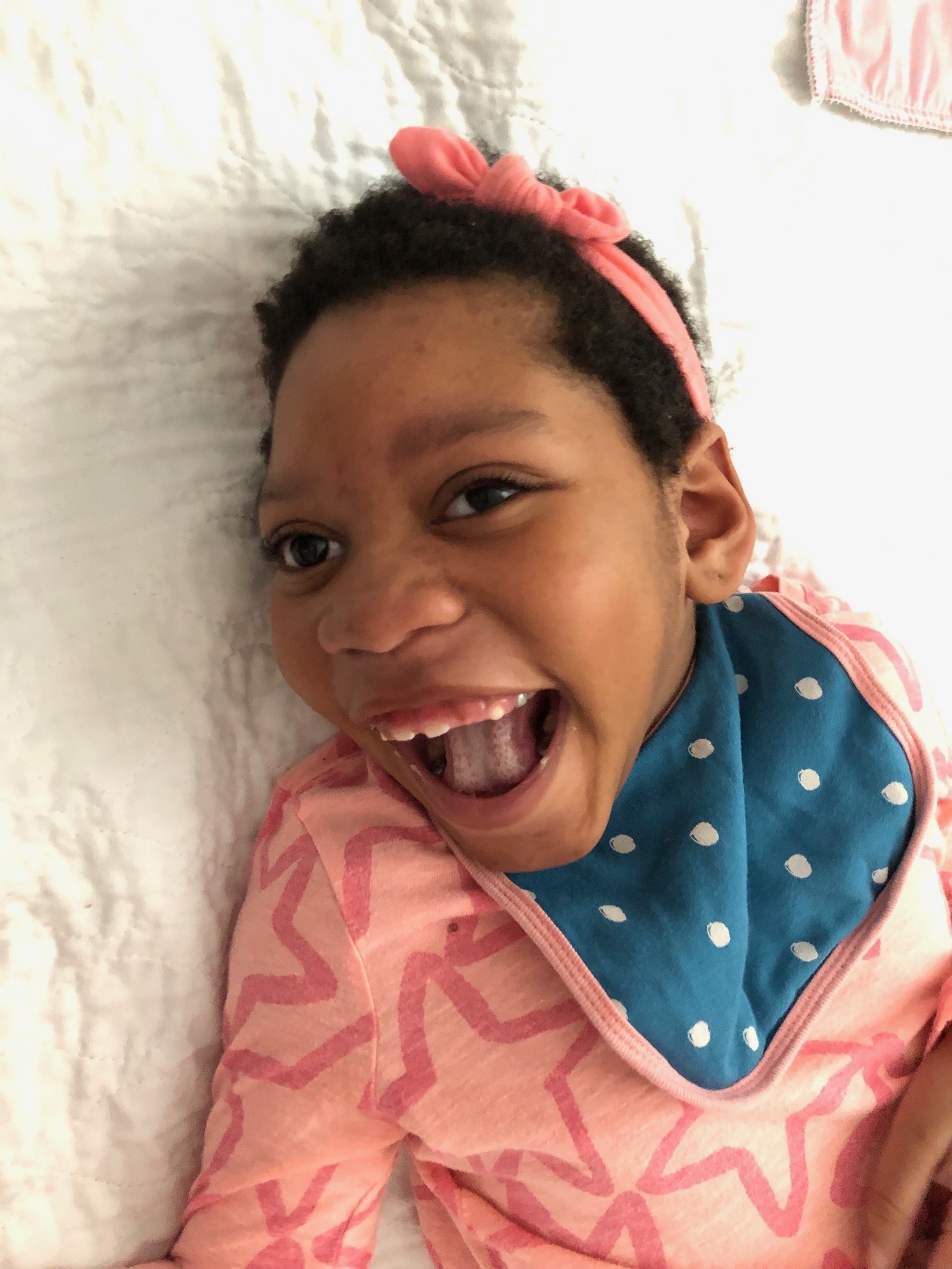
The morning before our last day, I received an unexpected message from our friend Rosean, the youth pastor at our co-op’s host church, who also serves as our co-op security person (and so much more). From the very first day of classes, he recognized our challenges and went out of his way to help Tess navigate the stairs, going so far as to meet us at the car most weeks. He always had an encouraging word and a smile to share and never once made us feel like a burden. It was a gift. But when he sent me photos of a new ramp he had installed over the steps that Tess needed to navigate the most each school day, I was so overcome with emotion that I had to sit down. 

I had just had a conversation the previous week with one of our co-op board members about my concerns for managing the next school year, knowing I will likely have less resources and assistance to help Tess and Lydia during the times I will be teaching and serving in the co-op. Any parent in a truly collaborative co-op (as opposed to a drop-off program) faces challenges juggling their own family’s needs with their responsibilities to teach and serve, but when your child is fully dependent on assistance to navigate her environment and meet basic care needs, there are extra struggles. This ramp was an act of seeing and empowering Tess while letting me know that I am not alone in my struggle to manage a positive but often challenging day.

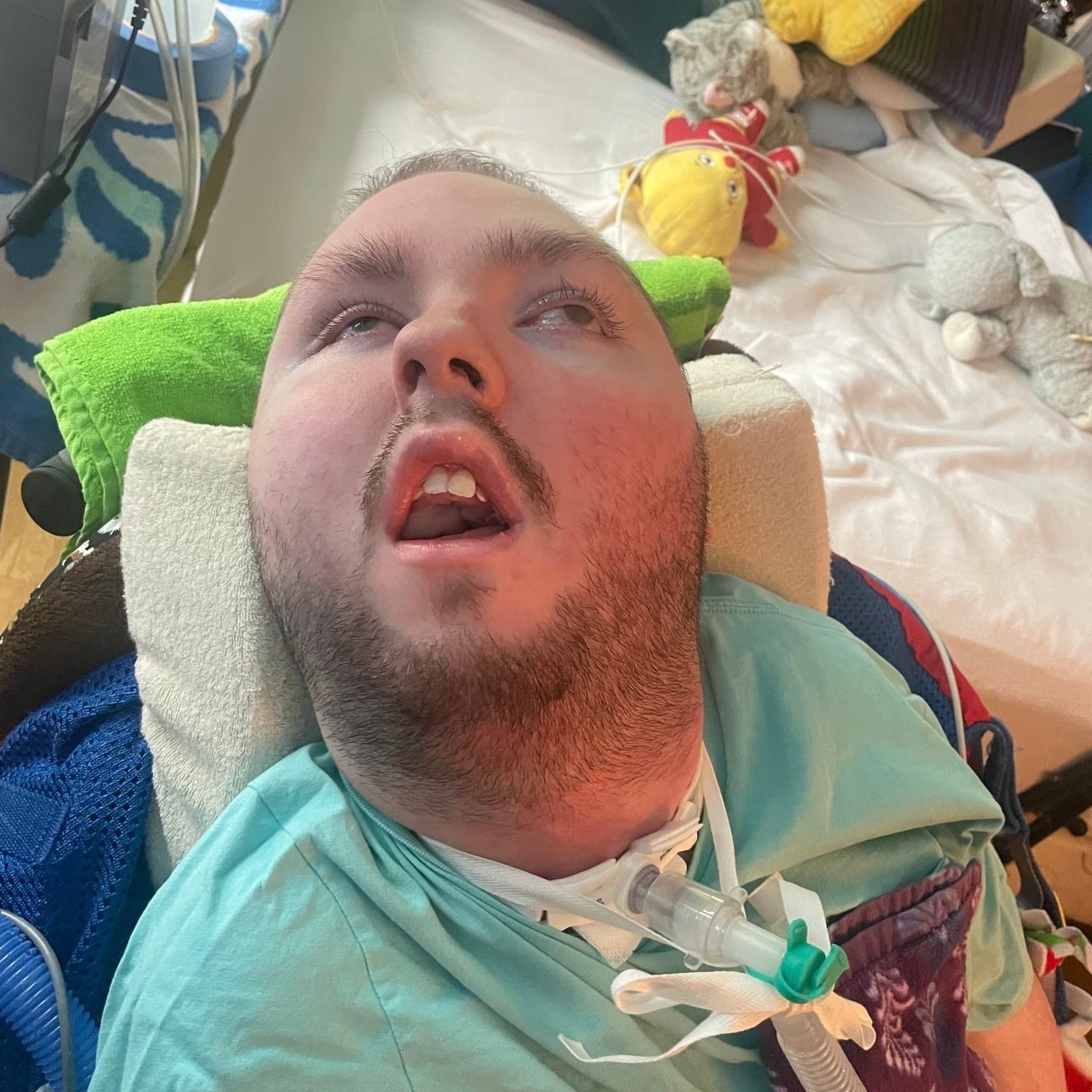
Vision is often enhanced through contrast and this experience helped solidify a decision with which I have been wrestling for the past few months. I shared in a previous post that I was excited to be starting a Princeton Theological Seminary (PTS) graduate program in Theology that focuses that focuses on Justice and Public Life. In that post, I also shared that there were portions of the program I was not sure how I would fulfill but that I was trusting God to make a way. Soon after sharing my decision to commit to the program, I learned that Tess needed her sixth cerebral shunt revision. This one was planned, while the others have been emergent; however, each one has reminded me of the unpredictability of my life as a single mom to kids with medical challenges. While I do believe in trusting God to make a way, I also believe in exploring options and planning ahead. That process led me to realize that the PTS program was not accessible to me.

I have thought a lot about accessibility and inclusion for my kids but have recently come to realize that parents of kids with disabilities need inclusion and accessibility too. We live in a constant state of alert, balancing the needs of a typical child or young adult with the often complex needs that come with our kids’ unique challenges. The basic things like an unexpected trip to the store can be complicated, and we live on the precipice of emergency. Very few, if any, people can step into our life, even on an extremely temporary basis, which limits our mobility, reliability, and especially, our control. Our “no” is often an “I wish” or “If only…,” and our “yes” is always a “hopefully.” It’s a beautiful but complex life that both expands and restricts us. We wouldn’t want a different life and most definitely not a different child, but the world rarely sees or understands our internal or external struggles. Our focus is on securing accessibility and inclusion for our kids but truthfully, we need both as well.

One of my favorite things “hobbies” for most of my life has been following North Carolina Tar Heel basketball. In basketball, players often use their pivot foot to create space against a defender. If I am trying to make a play on the basket and I lift the ball over my head, the defender can fill the void and hinder my movement. If I hold the ball directly in front of me, it is likely to be knocked away. My best option is to use my pivot foot, step forward, and sweep through to back my defender up, creating space for myself to move in a new direction and make a play on the basket.

I could have remained in the PTS program and hoped for the “act of God” that would be necessary for me to fulfill the program component that is just not conducive with my primary responsibilities, but if that act never came, I would not complete the degree. Instead, I decided to pivot and survey the court for other options. And the vision I gained from that pivot showed me more options than I had known of last summer when I first discovered PTS’s program. One of them quickly emerged as ideal.

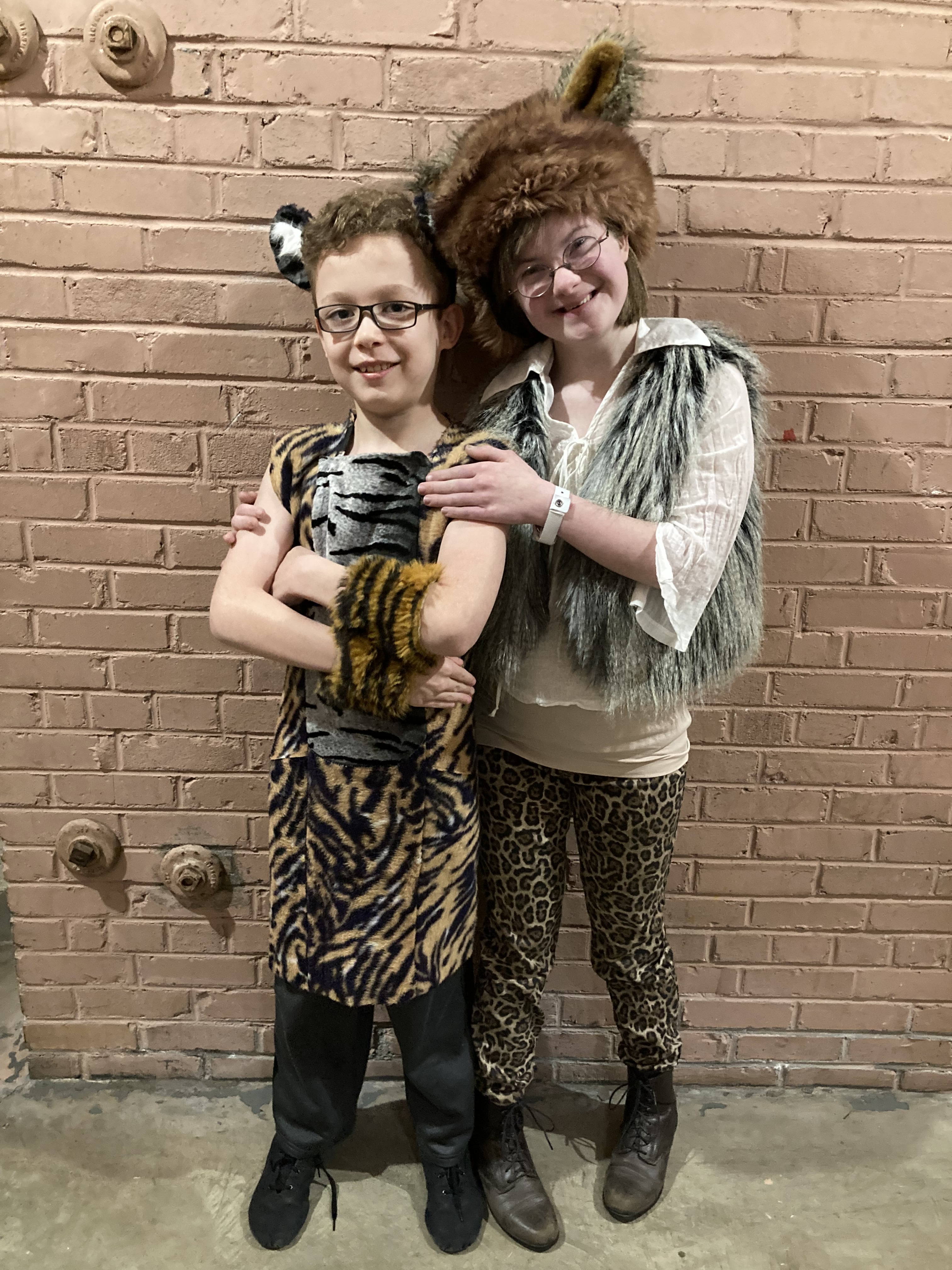
Next week I will begin classes toward my Master of Ministry (MMin) degree in Theology and Culture (with an emphasis on Justice) at St. Stephen’s University. I am beyond excited! It would take another post to share all the many ways St. Stephen’s is perfect for me. In short, their mission perfectly aligns with my own:  

“The Mission of St. Stephen’s University is to prepare people, through academic, personal, and spiritual development, for a life of justice, beauty, and compassion, enabling a humble, creative engagement with their world.”

And equally valuable—even essential—to me, SSU is inclusive and made itself accessible to me as a single parent of kids with exceptional needs. From my first inquiry to the creation of an outlined course of study that provides me with options for a variety of scenarios that may occur in this beautiful but often out-of-my-control life, they sought to understand my situation on more than a surface level and responded to it, not just with sympathy or even empathy but with action. I cannot describe the peace that accompanied that for me. Now instead of beginning a program with a cloud of uncertainty hovering above me, I begin from a firm, supportive foundation that frees me to be focused and enthusiastic!

Looking back, I see God directing me toward SSU all along in small, subtle ways that I could not have seen if I continued to cling to the ball of PTS’s program or raise it up high to keep someone from taking it from me. I would have either lost the ball or had obstructed vision and movement. Instead, I was able to pivot and open space for myself to do something better than what I originally planned. In the process, I learned that inclusion and accessibility matter for me, too, and that just as I do for my kids, I need to advocate for that and surround myself with the people and communities who see and empower me to do so.
God Bless Us, Every One!

According to his biographer, Charles Dickens “thought of A Christmas Carol as a way to, ‘help open the hearts of the prosperous and powerful towards the poor and powerless….’” He first intended to write a pamphlet that would be called “An Appeal to the People of England on behalf of the Poor Man’s Child,” but after thinking about it for less than a week, he “decided instead to embody his arguments in a story, with a main character of pitiable depth.”  By putting faces on societal issues through relatable characters such as Bob Cratchit, Tiny Tim, and the infamous Ebenezer Scrooge, Dickens enabled audiences to truly see and begin to understand the messages he wanted them to hear, messages that remain incredibly relevant today.

For the past ten weeks, a Hampton Roads company of actors and actresses have gathered for hours every Saturday and on various days throughout the week, rehearsing to bring Dickens’ story to life. Arts Inclusion Company (AIC) is “a theater community where all are ABLE.” AIC utilized Dickens’ memorable characters portrayed by incredible actors and actresses to convey its own message that indeed we are ALL able and deserve to be seen.

When AIC announced auditions for A Christmas Carol, I was one of the first to sign my kids up. I had eagerly awaited our return to “Neverland,” and was excited for Tess to have the chance to participate this year. Lydia prepared a rendition of “I Love Trash” by Oscar the Grouch, complete with a prop, but was too shy to perform it in the audition. Titus, who has a self-described “short memory,” forgot the lyrics he was going to sing and ended up dancing for his audition. Tess sang the only song she had yet sung on her own from memory—“Happy Birthday.” 

After Scrooge observes the home and family of his employee Bob Cratchit, he is baffled by the fact that “They have so little and yet they rejoice.” Christmas Present responds, “They have infinitely more than you observe, Ebenezer Scrooge. They have each other. The world is full of people like these, man. It is only that you have never lifted up your eyes to see. See them now…”

Each offering made by my kids and all the others who auditioned that day was more than enough because the AIC Board members and volunteers have mastered the lesson Scrooge learned through his Christmas Eve encounters with the ghosts. They are able to see “infinitely more” than can be observed.

When the cast list came out, Tess, who first started speaking about five years ago, ate her first food by mouth three years ago, just began drinking water by mouth in May of this year, and had only recently sung “Happy Birthday” from memory was cast in the role of Tiny Tim.

In early 2020, I was asked to share Tess’s story as part of a video series our church was doing on Miracles. The turnaround time was short, so I quickly sifted through six and a half years of photographs and video clips that my son Jonah and I compiled into a video the church could show on Sunday morning. At the very end of that video is footage of the first time Tess walked with a little lofstrand crutch her physical therapist thought we should try. I called it one of the “thousand little miracles” that had comprised Tess’s first six and a half years of life. 

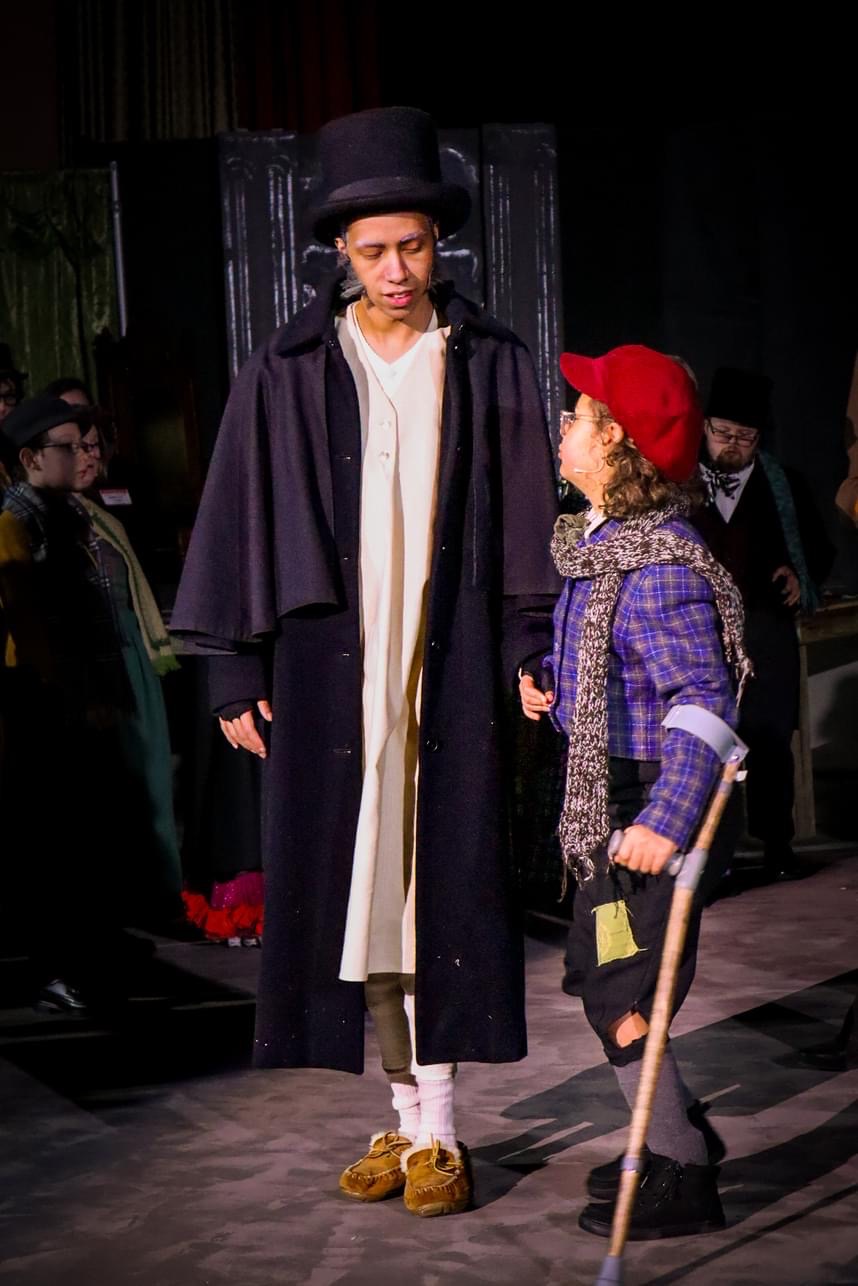
Three and a half years and a thousand more miracles later, I accepted Tess’s role as Tiny Tim in AIC’s production with faith that God would equip her to fulfill it. I could never have imagined how very perfectly suited she would be for the part and how much she would embrace it. Watching Tess deliver her lines and sing her songs with the same infectious laugh I described in the Miracles video, and seeing her walk to the front of the stage with her lofstrand crutch at the end of the show holding the hand of, not an attendant or family member, but a fellow actor—another overcomer—was an experience for which I do not have words.

By the end of A Christmas Carol, Ebenezer Scrooge has learned the lesson the Ghost of Christmas Present set out to teach him: “A man may have nothing in this world but he can make it a paradise by the way he lives his life. You have it all before you and go about with your eyes cast to the ground. Look up, Ebenezer, look up.” With eyes to see, Scrooge transformed into “as good a friend, as good a master, and as good a man as the good old City knew,” a man whose “own heart laughed,” and a man who “knew how to keep Christmas well.”

I have been privileged to watch Tess transform from a premature infant whose MRI images evoked either doom-and-gloom prognoses or intolerable pity to a walking, (constantly) talking, singing, sibling-annoying, joy-filled child who has gifts to nurture, purposes to fulfill, and hearts to touch. All because select doctors, therapists, attendants, friends, and family chose to see “infinitely more” in her than could be observed.

Dickens concluded his novella with a blessing, “And so, as Tiny Tim observed, God bless Us, Every One!” As often happens with powerful, meaningful words like love, hate, or truth, our modern society has conscripted the word “bless” and twisted into something that varies from religious speak (#blessed) to Southern falsity (“bless her heart”) and everything in between. Being blessed has come to represent success, material wealth, status, health, and perfect relationships. But the actual meaning of bless is “to ask God to look upon with favor.” Not a party favor or a favor from a friend, but “approval, support, and a kindness that is beyond what is expected.” 

Each performer in AIC’s production has a story that includes countless people who could see “infinitely more” than they observed. I hope that every audience member who witnessed Tess’s performance this weekend and the performance of each and every actor and actress who shared the stage with her for these past ten weeks now has the eyes to see that ALL are able and deserve to be seen.

And as the very ABLE Tess (in the role of Tiny Tim) observed, “God bless Us, Every One!”

Photo Credit: Suzette Valentine (mom of Scrooge)

Who’s the GOAT?

IMG-4799 copy

When you hear the question, “Who’s the GOAT?” What comes to mind?

Perhaps if you are a basketball fan, you think of Michael Jordan?…a concert lover, Taylor Swift?…a football buff, Tom Brady?

Arguments about the GOAT—Greatest Of All Time—span every context imaginable, from the sports field to the courtroom, from the theater to the boardroom. So how does one achieve GOAT status? Even Jesus’s disciples considered the question. In his gospel, Luke records that “[a]n argument arose among [the disciples] as to which of them was the greatest” (Luke 9:46, ESV).

The events leading up to that moment provide interesting context for their argument. The day before the argument took place, Jesus and three of his disciples had experienced the transfiguration. Peter was so enamored by the magnificence he encountered on the mountain that he suggested setting up camp there. Luke tells us that as they descended the mountain the next day, they were met by a great crowd. A man in the crowd shouted, begging for Jesus to look at his son, who was seized by a spirt that mauled him and caused him to foam at the mouth. The father told Jesus, “I begged your disciples to cast it out, but they could not.” After exclaiming his frustration with a “faithless and perverse generation,” Jesus “rebuked the unclean spirit, healed the boy, and gave him back to his father” (v. 42). Luke tells us that “all were astounded at the greatness of God” (v. 43). In the midst of that amazement, Jesus told his disciples of his impending betrayl, but “they did not understand this” and were afraid to ask Jesus about it. Instead, this “argument arose among them concerning which one of them was greatest” (v. 46). While no direct correlations are made in Scripture, the disciples were clearly enamored by and focused on greatness while also struggling to be effective in their healing ministry and even to understand the One who had empowered them for it.

Jesus recognized their struggle, resolved their argument, AND definitively answered humankind’s ongoing argument about who is the GOAT:

“But Jesus, knowing the reasoning of their hearts, took a child and put him by his side and said to them, ‘Whoever receives this child in my name receives me, and whoever receives me receives him who sent me. For he who is least among you all is the one who is great’” (Luke 9:47-48, ESV).

So into the disciples’ argument, with actions and words, Christ spoke five truths:

When we seek greatness, God knows.

The least are brought closest to Christ.

Receive the least and you receive Christ.

Receive Christ and you receive the Father.

The least among us is greatest.

Luke did not describe the disciple’s reactions to Jesus’s resolution of their argument, but it was likely revolutionary to them. Like us, they had their ideas about greatness and clearly wanted to be the GOAT themselves. Fortunately, in his gospel Matthew also recorded Jesus’ insights related to GOAT status as He taught his disciples on the Mount of Olives:

“When the Son of Man comes in his glory, and all the angels with him, then he will sit on his glorious throne. Before him will be gathered all the nations, and he will separate people one from another as a shepherd separates the sheep from the goats. And he will place the sheep on his right, but the goats on the left. Then the King will say to those on his right, ‘Come, you who are blessed by my Father, inherit the kingdom prepared for you from the foundation of the world. For I was hungry and you gave me food, I was thirsty and you gave me drink, I was a stranger and you welcomed me, I was naked and you clothed me, I was sick and you visited me, I was in prison and you came to me.’ Then the righteous will answer him, saying, ‘Lord, when did we see you hungry and feed you, or thirsty and give you drink? And when did we see you a stranger and welcome you, or naked and clothe you? And when did we see you sick or in prison and visit you?’ And the King will answer them, ‘Truly, I say to you, as you did it to one of the least of these my brothers, you did it to me’” (Matthew 25:31-40, ESV).

Christ’s response to our focus on or pursuit of greatness is to seek out the least among us, instruct us to receive the least, and declare that when we serve the least, we serve Him. Four times in Luke 9:48, Jesus repeats the word receives: “Whoever receives this child in my name, receives me, and whoever receives me receives him who sent me. For he who is least among you all is the one who is great.” The Greek word which translated “receives” is “déchomai,” which means “to take with the hand; not to refuse friendship; to receive into one’s family; to receive of the thing offered in speaking, teaching, instructing.”

What does this look like?

In his book The Power of the Powerless: A Brother’s Legacy of Love, author and teacher Christopher De Vinck shared the story of growing up with his brother Oliver who suffered severe brain damage caused by a gas leak that occurred during his mother’s pregnancy and left Oliver completely dependent for his entire life—unable to see, talk hold his head up, or hold anything in his hand. De Vinck described his parents’ response to the doctor’s diagnosis of Oliver’s condition:

When our children are in pain, we try to heal them. When they are hungry we feed them. When they are lonely we comfort them.

‘What can we do for our son?’ my parents wanted to know.

Dr. De Lange said that he wanted to make it very clear to both my mother and father that there was absolutely nothing that could be done for Oliver. He didn’t want my parents to grasp at false hope.

‘You could place him in an institution.’

‘But,’ my parents answered, ‘he is our son. We will take Oliver home, of course.’

The good doctor said, ‘Then take him home and love him’” (p.11).

De Vinck then shared the influence his parents’ decision had on his life:

“Oliver still remains the most hopeless human being I ever met, the weakest human being I ever met, and yet he was one of the most powerful human beings I ever met.

As a teacher, I spend many hours preparing my lessons, hoping that I can influence my students in small, significant ways. Thousands of books are printed each year with the hope that the authors can move people to action. We all labor at the task of raising our children, teaching them values, hoping something ‘gets through’ to them after all our efforts.

Oliver could do absolutely nothing except breathe, sleep, eat, and yet he was responsible for action, love, courage, insight.

For me, to have been brought up in a house where a tragedy was turned into a joy, explains to a great degree why I am the type of husband, father, writer and teacher I have become” (p. 12).

Near the end of his book, De Vinck reflected, “Looking at [Oliver], I saw the power of powerlessness. His total helplessness speaks to our deepest hearts, calls us not merely to pious emotions but to service. Through this child, I felt bound to Christ crucified—yes, and to all those who suffer in the world. While caring for Oliver, I also felt that I ministered in some mysterious way, to all my unknown brothers and sisters who were and are, grieving and in pain throughout the world. So through Oliver, I learned the deepest meaning of compassion’” (p. 87-88).

The lives of two of my friends share similarities with Oliver’s: Joy and Collin. Joy was adopted by my friends, the Jacob family, when she was four years old. Soon after, she was diagnosed with a rare disease, and her family was told she would only live about another year. Two weeks ago, Joy passed away peacefully at the age of eleven, more than double her life expectancy. No one in Joy’s life lived under those or any other expectations, however, and as Joy’s neurologist shared with the family after she passed, “She exceeded my expectations in every way and showed me that love can carry a child beyond what science tells us.”

I attended Joy’s Celebration of Life this weekend where the sanctuary was filled with images of her beautiful smile, sounds of her laughter and the songs she loved, and the people who had cared for her day-to-day needs proclaiming that what they received from Joy was far more than they gave. Her mother, my friend J.J., shared with me, “It still just blows my mind how many people were impacted by Joy–quadriplegic, non-verbal, severe intellectual challenges, in addition to all of her medical challenges. It all humbles me. God used Joy to change lives. How can I think that God can’t use me?” 

Just a few miles away from the home where Joy lived, Collin lives with his mom, dad, and sister. Collin suffered a traumatic brain injury at birth that left him completely dependent on others. He was not expected to live to be a year old. Instead, thanks to the loving care of his family, who also ignored expectations, Collin is finishing his second decade of life—a life that led my friend Dianna, his mother, to not only receive and serve her son despite his significant needs, but to learn from him that everyone has a song. Dianna has devoted her life to arts inclusion—teaching voice and musical theater to the most accomplished students at the Governor’s School as well as to individuals who are nonverbal like Collin. Dianna’s Vocal Inclusion studio is based in her home so that her son can always be surrounded by music. Through her work, students of all abilities—including my own—are given the best stages and the most notable audiences with which to share their songs. 

Continue reading

Neverland

In April 2015, I attended Seussical, the first performance of the Arts Inclusion Company (AIC), which defines itself as a “company where people of All Abilities are welcomed to participate in all aspects of theatrical arts.” I described the experience as “a glimpse of the Kingdom on earth—a portrait of how life could be if we all risked putting our individually broken selves together to create something much more complete and meaningful than we are capable of alone.” I knew that night that when Lydia and the twins were old enough, we would join AIC. A few life interruptions and a global pandemic later, we did just that!

What I witnessed from my seat in the audience was just a taste of what we experienced as participants. From the first rehearsal to the final curtain call and every moment in between, the kids and I felt welcomed, valued, safe, and accepted. Watching the show come together over three months gave me a picture of what we can create when ego and competition and perfection are not just subdued but entirely absent.

Of all the many positive effects Lydia’s birth has had on my life, one has stood out from her very first year of life. I realized almost immediately that having a child with Down syndrome changed the way the world saw our family. Though it manifested in different ways, it was tangible. In the eyes of friends, family, and strangers, we forever lost all possibility of being a “picture-perfect family” in image and in substance. Some looked at us with pity, others with discomfort. Many just looked away altogether. Those with personal experience looked at us with understanding and joy. Some with no experience were at least curious and willing to join us on our unexpected journey. 

That lost possibility for perfection transformed my life from one of pressure I did not even recognize to one of freedom. Through my children’s “dis”-abilities, I found an entirely new way to exist—one free of pressure, expectation, timelines, perfection, and pride. As Lydia grew, and with her my exposure to and appreciation for a world of people I had previously scarcely acknowledged, I began to question the dis- in disability. I would say, half joking, that perhaps it was those of us who lacked the third copy of the 21st chromosome that were actually disabled, since Lydia’s perspective and capacity for love seemed far more Christlike than most people I knew. Lennard J. Davis later gave me the academic explanation for my instinctive insight in his discussion of normalcy as a construct. Davis wrote that “the ‘problem’ is not the person with disabilities; the problem is the way that normalcy is constructed to create the ‘problem’ of the disabled person.” My transformation from a world that viewed imperfection as a problem to be avoided to one of freedom from pressure carried me through even greater “imperfections” that our family would face in the years to come. 

Living free in a world dominated by pressure and expectation, however, can be very isolating and lonely at times. Society doesn’t place much value on imperfection and doesn’t know what to do with families like ours. As an (almost) single mom in communities where divorce is taboo and with only children with special needs remaining in the home, I am often the person everyone smiles at and waves to—but from afar. In an interview, Kate Bowler once shared that a common lament of individuals who have had “a big before and an after in their life” is that, “I’m everybody’s inspiration but nobody’s friend.” Being a part of AIC’s production of Peter Pan was like entering a world filled with people who live in the freedom of imperfection—a world of instant friends for me and my children. It felt like going home.

J.M. Barrie created the world of Neverland in his 1911 novel originally titled Peter and WendyHe described the Neverlands as an invention of a child’s mind, which “keeps going round all the time,” but is “always more or less an island, with splashes of color here and there.” Barrie acknowledges that “the Neverlands vary a good deal,” with one child’s differing from another’s, but “on the whole the Neverlands have a family resemblance” and are close enough to one another to facilitate grand adventures. Neverland is a boundary-free place where limitations of reality are suspended and belief abounds. Anything is possible with a little fairy dust…even flying. 

The research I conducted for my dissertation was based on the work of a psychologist named Reuven Feuerstein who believed no individual was without hope or the propensity to change. When I discovered his work, I devoured everything I could read from this man who saw potential of those society often discounted and even discarded, long before neuroscience scientifically validated his work. Feuerstein said that children with neurodevelopmental disorders such as Down syndrome can be helped and that “chromosomes do not have the last word.” 

My life’s work has been to parent and educate all of my children in a way that left the world open for them to pursue whatever gifts, passions, interests, or callings God placed in their hearts. For my children who don’t fit society’s image of perfection, that has included protecting them from anyone and anything that makes them feel “less than.”

During the adventures of the Darling children in Peter Pan, Tinkerbell protects Peter by drinking his poisoned medicine. As she lays dying, Peter is only able to save her by calling on those around him to believe in fairies. From the earliest rehearsals to the final matinee, that scene resonated with me on so many levels. To live in this world, and especially to fly in it, my children need belief—belief in themselves that is protected and fanned like a flame by those around them. Sadly most spaces seek, whether deliberately or unintentionally, to extinguish that flame of belief. 

Our past few months being a part of AIC allowed us to spend time in a real-world Neverland, where limitations of reality are suspended and belief abounds. I saw all ages, all races, all genders, all types of abilities come together to pool their gifts, talents, and passions to create something beautiful to offer to the world. Everything was accepted and welcomed—all that was required was a willingness to show up. Expectation, judgment, pressure, and perfection were absent. Friendship was granted simply by presence. No explanations or apologies were needed. The experience was beautiful and like Peter, I never wanted to leave. 

But the final curtain closed and we returned to our everyday lives in a world that sees more limitations than possibilities—a world that doesn’t know what to do with our imperfections and brokenness. But because we know that we are not as alone as it sometimes feels, we will keep venturing out into that world so that it can begin to see all the beauty that can come from brokenness–and maybe change its understanding of “normalcy” in the process. Like Wendy, we will return to Neverland every year we are able—for a little spring cleaning and a lot of adventure. And we will keep our dreams alive in the meantime—fueled by belief…and perhaps a little fairy dust. 

Alone in a Life Full of People

Warning: This is a “special needs mom” post. Read at your own risk. This is not uplifting or inspirational or encouraging.  And it may not be biblical.  But it is honest.  Maybe my “typically developing” mom friends can relate in some way, but probably not. Forgive the specialized rant, but I need to write this to keep from going MAD.

Have you ever had a life so full of people that you feel utterly alone most of the time? I just really want to push MUTE, so I can’t hear all of the experts who would like to tell me how to live my life and do my job. This sounds harsh. I know. I’m sorry. Sort of. But sort of, I’m not.

This is a partial list of the consultants I deal with on a regular basis: physical therapist, occupational/feeding therapist, personal care attendant, vision therapist, neurosurgeon, developmental pediatrician, child psychologist, Early Intervention service coordinator, ophthalmologist, endocrinologist, cardiologist, orthodontist, pediatric dentist, speech therapist, orthopedist, physical medicine physician, neonatologist, dietician, ENT…

There are more, but I can’t remember them at the moment, and I think the point is made. These specialists are amazing. They are well-trained, great with children, filled with endless knowledge and caring hearts. But they are DRIVING ME CRAZY right now. They really are.

First of all, they overwhelm me. I could spend every waking hour trying to implement their suggestions and follow their protocols, and I would never be able to accomplish what they request.

Second, they contradict each other. And when they find out that they do, watch out! Because then I have to hear why one is right and the other is wrong. And that does not help me one bit.

Third, every conversation I have with any of them leaves me feeling guilty. Which pretty much means I feel guilty all of the time because I hear from one of them almost every day.

Fourth, they have NO concept of what my life is really like—how many people are constantly on my mind with great and pressing needs and how very isolating it is to be a “special needs mom”—four times over—and a “typically-developing mom”—also four times over. Everyone is pretty much scared to engage—so they don’t—or they do, but from a comfortable distance.

Fifth, they have no clue how wearisome it is to constantly have people in your house—several times a week—helping you but also making you feel like you live under a microscope. And there is no hiding that your dog pees on the floor and your kids pretty much live like pigs and relationships in your family are far from perfect.

Sixth, they don’t seem to account for the fact that I function on so little sleep that I can’t remember the last time I slept for more than three hours in a row—it was early September 2013, if I recall.

But the good news is that all this keeps me praying and alerts me constantly to my dependency on God. He called—He will equip. He will take my meager efforts and my utter failures, and He will make them into abundance. Fish and loaves all over again. He will. I know it. I believe it. I trust Him. His opinion and expert advice are all that matter. (Repeat to self hourly.)

That’s all. I feel better. Just needed to vent for a moment…survival tactic…prayers welcome…