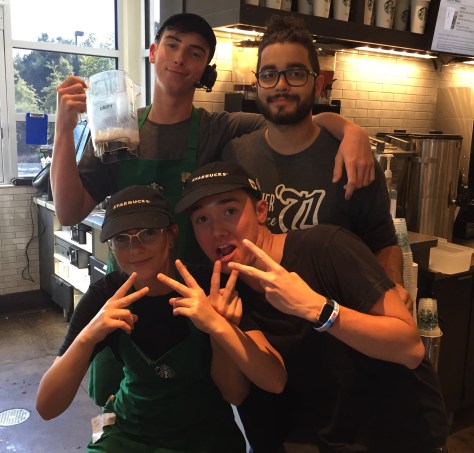
President’s Day 2018. I parked my white Toyota Sequoia in front of the Hanbury Road Starbucks just as I had countless times before. I pushed the café door open with my shoulder, dropped my bags beside one of the small, round tables, and walked shakily to the counter to place an order. When the barista in front of me asked what I wanted to drink, my brain froze. “I don’t know,” I stammered, staring at the menu blankly. “I have no clue.” And then I started to cry.
Right there in the middle of Starbucks, the stress of the day leaked out all over the register display of gift cards and packaged sweets. My shoulders shook as the silent tears increased and all the bottled-up tension finally escaped.
I had made a mistake that morning—did something I thought would be helpful and would definitely make life a little safer for me—and it was not well-received. By any stretch. I had paid. Over and over again—all day long.
I had been coming to this Starbucks for years, but during the hellacious fifteen months in which my marriage went from bad to dangerously toxic, I practically lived there. Mostly I worked—developing curriculum and grading papers for online English courses. I started to recognize other regulars and knew many of the baristas by name. It was a friendly, comfortable place—my “third place” as defined by sociologist Ray Oldenburg.[1] But as the months went on, it became so much more.
I took my dinner there every night so I could eat it in peace. Each evening, I watched out the front window of our home, so I could perfectly time my exit and guarantee sparing the children exposure to another uncensored encounter.
Seven minutes later, I opened another door where my heart rate returned to normal and the tension I carried could dissipate—for a few hours at least. My “third place” became my safe space. A space free from caustic words and actions that were eating away at my soul.
It eventually became a place to plan my escape. A place to meet the realtor who would help me find a peaceful home for myself and my kids. A place to talk freely to my parents and brother who made it financially possible for me to even consider doing that. A place to meet friends who would help me bolster the strength it would take to walk away from all that I had known for the past twenty-six years.
On President’s Night when Sarah and Levi decided that a Black and White Mocha seemed the appropriate drink for someone in my condition, walked the drink over to my table, and asked if there was anything they could do to help me, I stammered an apology and mumbled that I was in a marriage that had become “kind of abusive” and had just had a really bad day.
Sarah offered to pray for me. Said she hoped I didn’t mind if she said that. I told her I didn’t mind at all. I would really appreciate that.
In the coming months, I got to know Sarah. And Ryan, one of the other regulars. And Sam and Stephanie and Mateo and Jake and Sing and Rehoboth. And then Dakotah and Liz and Mackenzie and Hayley. They knew my drinks. They knew my kids. They knew my story. And I started to know theirs. They were part of God’s provision in an unimaginable tempest.
Some of them helped me move my belongings—one carload at a time—into my new, peaceful home. Some of them spent their tens and thirties encouraging me through the hardest days—giving advice or just listening. They wrote messages on my cups—“We love you, Mom! You’ve got this!” They gave me rides, helped with my kids, watched our dog, visited our home. They became family.
There is a void in the system for people who experience invisible abuse—the kind that leaves internal scars. And when you have multiple kids with special needs, you aren’t exactly portable or welcome to crash indefinitely in a friend’s guest room. And in your search for safety and peace, the most unlikely place—an icon of pop culture, a chain, a place like thousands of others around the country—steps up to provide what nothing and no one else could.
I have been to a lot of coffee shops over the years. They are great places to work, meet friends, and get a sugar or caffeine fix. And I have met some friendly, kind baristas over the years—Marcus and Paco and Taylor and Nick, among others. But there is something special about “my Starbucks.” An atmosphere of community and warmth created by the people who work there—people who do more than craft beverages. They go beyond their job description to really see people and care about them. And sometimes, without even knowing it, they throw a lifeline to a drowning person.
When Sarai and Abram took matters in their own hands and “helped” God fulfill His promise of a child by having Abraham sleep with Sarai’s servant Hagar, the two women understandably lashed out at one another. Hagar fled to the wilderness. It’s easy to imagine how alone she felt there—pregnant with her mistress’s husband’s child, guilty for treating Sarah “with contempt,” battered by Sarai’s “harsh” treatment of her, alone, afraid, worthless? But then “the angel of the Lord found her by a spring in the wilderness” and asked where she was going. When she said she was fleeing from her mistress, the angel told her to return and submit to her and then made incredible promises to her about the power of the son she would bear. And Hagar “called the name of the Lord who spoke to her,” saying, “You are a God of seeing…Truly here I have seen him who looks after me.” And she named the well “Beer-lahai-roi,” which means “well of the Living One who sees me.” (from Genesis 16:1-14, ESV)
I used to go to Starbucks for the drinks. For the workspace. To meet with others. I guess I still do those things. But last year I went for protection—a safe space where I could breathe and eat and not be afraid. And in that space, God saw me and provided for me. My Beer-lahai-roi.
I still visit the Hanbury Road Starbucks almost every day—I’m primarily a drive-thru customer now because single motherhood doesn’t lend itself to hours in a coffee shop. But that’s just fine by me. I recognize their voices on the intercom, and they know my drinks—usually a “Venti Blonde Latte, add Chai” and “two tall, iced Decaf waters” for my constant companions.
I no longer need a safe space. God provided me a beautiful home where I can eat and breathe and sleep in peace. But I still have hard days, and one of my first instincts is to go to my “third place.” Because I am guaranteed to see a friend there, to get a smile and a word of encouragement. To remember that God sees me and provides. Always.
And the drinks aren’t bad either.
“I am weary with my moaning; every night I flood my bed with tears; I drench my couch with my weeping. My eye wastes away because of grief; it grows weak because of all my foes. Depart from me, all you workers of evil, for the Lord has heard the sound of my weeping. The Lord has heard my plea; the Lord accepts my prayer.” (Psalm 6:6-9, ESV)
[1] https://www.nytimes.com/roomfordebate/2014/04/13/the-pros-and-cons-of-gentrification/every-community-deserves-a-third-place


 “And the Lord hardened the heart of Pharaoh king of Egypt, and he pursued the people of Israel…The Egyptians pursued them, all Pharaoh’s horses and chariots and his horsemen and his army, and overtook them encamped at the sea…When Pharaoh drew near, the people of Israel lifted up their eyes, and behold, the Egyptians were marching after them, and they feared greatly. And the people of Israel cried out to the Lord…And Moses said to the people, ‘Fear not, stand firm, and see the salvation of the Lord, which he will work for you today…The Lord will fight for you, and you have only to be silent.’ The Lord said to Moses, ‘Why do you cry to me? Tell the people of Israel to go forward. Lift up your staff, and stretch out your hand over the sea and divide it, that the people of Israel may go through the sea on dry ground…Then Moses stretched out his hand over the sea, and the Lord drove the sea back by a strong east wind all night and made the sea dry land, and the waters were divided. And the people of Israel went into the midst of the sea on dry ground, the waters being a wall to them on their right hand and on their left. The Egyptians pursued and went in after them into the midst of the sea, all Pharaoh’s horses, his chariots, and his horsemen…And the Egyptians said, ‘Let us flee from before Israel, for the Lord fights for them against the Egyptians’…Moses stretched out his hand over the sea, and the sea returned to its normal course when the morning appeared. And as the Egyptians fled into it, the Lord threw the Egyptians into the midst of the sea. The waters returned and covered the chariots and the horsemen; of all the host of Pharaoh that had followed them into the sea, not one of them remained. But the people of Israel walked on dry ground through the sea, the waters being a wall to them on their right hand and on their left. Thus the Lord saved Israel that day from the hand of the Egyptians…Israel saw the great power that the Lord used against the Egyptians, so the people feared the Lord.” (Exodus 14:8-9a, 13a, 14-16, 21-23, 25b, 27-30a, 31a)
 “My hope is in you, God
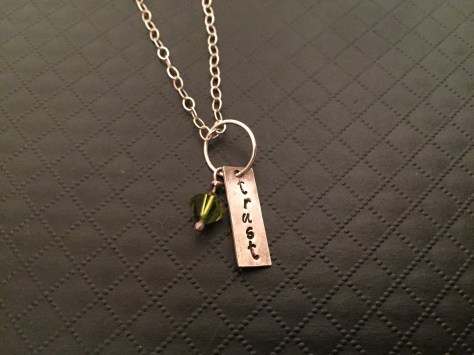 My friend Kiva makes beautiful jewelry. I noticed her creations the first time I worked with her in the Tab room at a speech and debate tournament two years ago. I almost never wore jewelry until I visited her Etsy shop and treated myself to some earrings (practically had to re-pierce my ears to wear them, but it was worth it!). When life took a southward turn two summers ago, I bought a necklace that Kiva had made…a simple silver chain with a small, stamped tag that said “But God…” I wore that necklace faithfully as I prayed fervently for its words to be true in my life. I could hear the future testimonies ringing in my mind…Our marriage was shattered, but God…A torpedo devastated our family, but God…She lost herself in grief, but God…
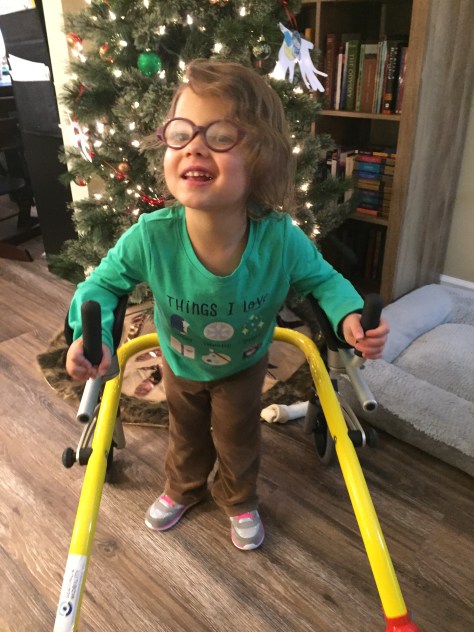 Last year I spent Christmas Day in the hospital with Tess. She had had five brain surgeries since October and had just gotten out of the PICU after spending over a month there trying to clear a shunt-line infection that settled in her brain and abdominal cavity and did not leave willingly. We listened to Christmas music, visited with the nurses, opened a few gifts, and tried to make the best of the day. Once she fell asleep, I went to a late showing of The Greatest Showman, a movie that I connected with so deeply that I saw it three more times in the two months that followed (not sure if it was the music, Hugh Jackman, or the story that ended the way I wished my story would end at that particular time). It wasn’t the first Christmas Day I had spent with a child in the hospital, but it was the first time I had not seen my other children on Christmas Day. My standard for a good Christmas Day was not falling apart, and I hadn’t. Mostly, I was just relieved that it was over.
 “Now when John heard in prison about the deeds of the Christ, he sent word by his disciples and said to him, ‘Are you the one who is to come, or shall we look for another?’ And Jesus answered them, ‘Go and tell John what you hear and see: the blind receive their sight and the lame walk, lepers are cleansed and the deaf hear, and the poor have good news preached to them. And blessed is the one who is not offended by me.’ As they went away, Jesus began to speak to the crowds concerning John.” (Matthew 11:2-7a, ESV)
  crosseyedliving